

Is your recovery team still working from Excel sheets, sticky notes and a shared WhatsApp group to track who promised to pay and by when? If so, you already know how much slips through the cracks. Agents call some accounts twice in one day and miss others for a week. They forget promise-to-pay dates. And nobody can tell you, at a glance, how much of this month’s overdue book your team has actually recovered.
This is exactly the problem debt collection software solves. For NBFCs, banks, collection agencies and loan DSAs, a purpose-built telecalling CRM for debt collection brings the auto dialer, the account data and the compliance record into one place. As a result, agents spend their time calling and closing instead of searching for the next number to dial.
In this guide, we’ll cover what debt collection software actually does, which features matter most, how it supports RBI compliance, and how to decide if your team needs one.
What Is Debt Collection Software?
Debt collection software helps recovery teams manage overdue accounts, dial borrowers, log outcomes, track promise-to-pay (PTP) commitments, and report on recovery performance. In short, it replaces spreadsheets and manual dialing with a structured, call-first workflow.
Unlike a generic sales CRM, this type of software centers on the specific data an agent needs during a call: outstanding amount, due date, delinquency bucket (DPD), PTP date and disposition. A standard CRM, by contrast, usually tracks generic sales fields like “budget” or “product interest” instead.
Who Uses Debt Collection Software?
Several kinds of businesses rely on this type of system:
- NBFCs and banks managing in-house recovery for personal loans, credit cards and consumer durables
- Third-party collection agencies working portfolios on behalf of multiple lenders
- Loan DSAs and fintech lenders following up on early-delinquency accounts
- Microfinance institutions tracking small-ticket, high-volume overdue accounts
- Insurance and subscription businesses collecting on unpaid premiums or renewals
What connects all of them is a high volume of outbound calls. Every call needs a log entry, every promise needs tracking, and every conversation needs to hold up if a borrower disputes it later.
Why Manual Recovery Processes Break Down
Most collection teams that outgrow spreadsheets run into the same problems.
Accounts get missed or double-called. Without a system tracking who called whom and when, agents either dial the same account twice in a day or forget it for a week. Either way, recovery rates suffer.
Teams don’t track PTP dates systematically. Say a borrower promises to pay by Friday. If that promise lives only in an agent’s notebook, nobody follows up when Friday arrives, and the team loses the opportunity.
Managers lack visibility into agent performance. They can’t easily see how many calls each agent made, how many accounts converted, or which delinquency bucket needs more attention.
Compliance records stay incomplete. If a borrower complains of harassment, the team needs call logs, timestamps and recorded outcomes to show what actually happened. A notebook simply doesn’t hold up as evidence.
Reporting eats hours instead of minutes. Pulling a recovery report together from multiple spreadsheets before a Monday review takes time away from calling.
Core Features to Look For
When you evaluate debt collection software, focus on features that map directly to how recovery teams work. Skip the generic CRM features that don’t apply to collections.
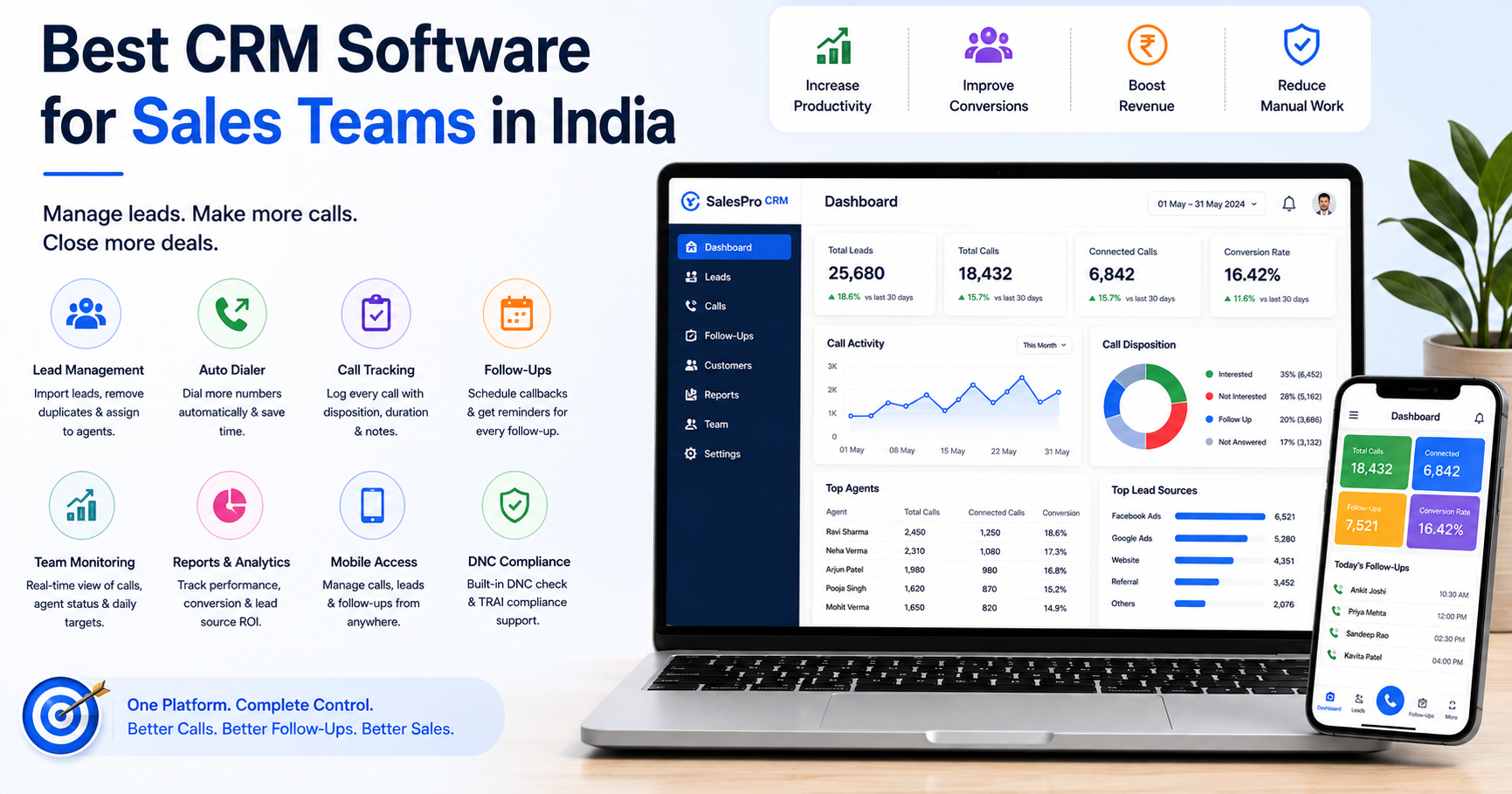
| Feature | Why It Matters for Debt Collection |
|---|---|
| Auto dialer | Queues accounts and dials automatically, so agents spend time talking, not dialing |
| Delinquency bucket (DPD) tagging | Lets teams prioritize accounts by how overdue they are |
| PTP tracking | Captures promise-to-pay dates and resurfaces them when due |
| Disposition logging | Records each call outcome – contacted, refused, wrong number, PTP given |
| DNC (Do Not Call) management | Skips DNC-listed numbers automatically, cutting compliance risk |
| Call recording & history | Keeps a record of every conversation for compliance and disputes |
| Pipeline by stage | Shows accounts moving through stages like Assigned, Contacted, PTP, Paid |
| Agent performance dashboard | Shows calls made, talk time, conversions and recovery amount per agent |
| Bulk portfolio import | Loads CSV or Excel portfolios of overdue accounts in one go |
| Mobile app | Lets field or remote agents call and log outcomes from a phone |
Not every team needs every feature from day one. For instance, a small in-house team of five agents may only need the auto dialer, PTP tracking and basic reporting. A larger agency managing multiple portfolios, on the other hand, will lean more heavily on bucket-wise prioritisation and multi-team reporting.
How Debt Collection Software Supports Compliance
In India, the Reserve Bank of India’s Fair Practices Code governs recovery calling, and it applies to banks, NBFCs and their outsourced recovery agents. Some widely cited requirements under this framework include restricting recovery calls to reasonable hours (commonly cited as roughly 8 AM to 7 PM), prohibiting abusive or threatening language, and requiring agents to identify themselves clearly on every call.
Debt collection software supports compliance in a few concrete ways:
- DNC list enforcement – the system automatically skips numbers that agents shouldn’t call, which reduces the risk of accidental violations.
- Complete call records – every call, its duration and its outcome get logged, and this matters if a borrower raises a complaint.
- Disposition tracking – agents leave a clear record of what they discussed and agreed on, which helps during audits or disputes.
- Consistent, script-based conversations – this reduces the chance of an agent straying into language that could sound intimidating.
That said, it’s worth being clear about limitations here. Software helps enforce and record compliant behavior, but it doesn’t replace training, oversight or a written recovery policy. Because RBI guidelines are directional, every lender or agency should confirm current requirements with legal counsel or compliance staff rather than relying solely on the CRM.
A Typical Debt Collection Pipeline
A well-structured pipeline gives every account a clear stage. As a result, managers can see recovery progress at a glance instead of digging through call logs. Here’s a common structure:
- Assigned – account allocated to an agent
- Contacted – first successful conversation with the borrower
- Promise to Pay (PTP) – borrower has committed to a payment date
- Partial Paid – borrower has paid part of the outstanding amount
- Paid – account fully recovered
- Escalated / Skip – account needs legal escalation or borrower is unreachable
By attaching an outstanding amount to each stage, a manager can see, in real time, how much of the overdue book is open versus recovered, and which agent is driving the most recovery.
Real-World Example: A Collection Agency Managing Multiple Portfolios
Consider a collection agency handling overdue personal loan accounts for two different NBFC clients. Without a system, agents would need separate spreadsheets for each client’s portfolio, and they’d have to manually track which accounts fall into 30-, 60- and 90-day delinquency buckets.
With debt collection software, the team imports each portfolio separately, and the system automatically tags accounts by DPD bucket. The auto dialer then prioritizes the queue based on that bucket. Consequently, managers can see recovery performance broken down by client portfolio and by agent – exactly the kind of reporting a client-facing agency needs to share with its lenders.
Note that this is a hypothetical scenario meant to illustrate how the workflow typically applies. Actual results will vary by team size, portfolio quality and calling discipline.
Common Mistakes When Choosing Debt Collection Software
- Picking a generic sales CRM and forcing collection workflows into fields meant for sales pipelines. This usually means missing fields like DPD bucket or PTP date.
- Ignoring the mobile experience for agents who work from home or the field. As a result, adoption often stays low because agents can’t log calls easily.
- Overlooking DNC and call-recording features. These matter more in collections than in most other calling use cases, given the compliance stakes.
- Skipping a check on import speed for large portfolios. A system that takes hours to load 10,000 accounts from Excel will slow down every collection cycle.
- Underestimating the importance of reporting. Recovery managers need daily and weekly visibility, not just a raw list of calls made.
How TeleCalling CRM Supports Debt Collection Teams
TeleCalling CRM’s debt collection setup is built around the way recovery teams actually work. It includes an auto dialer that queues accounts and skips DNC numbers automatically, along with lead fields built for collections: outstanding amount, due date, DPD bucket, PTP date, disposition and account ID. Its pipeline also follows a familiar recovery workflow: Assigned, Contacted, Promise to Pay, Partial Paid, Paid, and Escalated/Skip.
You can import portfolios directly from CSV or Excel, or connect them via webhooks, and the system logs every call with duration and outcome for record-keeping. Because a live team dashboard shows calls made, conversion and agent activity, recovery managers can run daily reviews without pulling data from multiple spreadsheets. For current plan details, check the pricing page.
Of course, this is one option among several in the market. The right fit for your team depends on your portfolio size, team structure and existing tools, so it’s worth evaluating against your own requirements rather than any single vendor’s claims.
FAQs
What is debt collection software used for? Debt collection software helps recovery teams manage overdue accounts, dial borrowers through an auto dialer, log call outcomes, track promise-to-pay dates, and report on recovery performance. In short, it replaces manual spreadsheets and notebooks.
Is debt collection software different from a regular CRM? Yes. A regular sales CRM centers on deals and prospects. Debt collection software, however, centers on overdue accounts, with fields like outstanding amount, DPD bucket, PTP date and disposition that a standard CRM typically doesn’t include.
Does debt collection software help with RBI compliance? It supports compliance by enforcing DNC lists, recording call details and logging dispositions. However, it doesn’t replace a written compliance policy, agent training or legal review – those remain the lender or agency’s responsibility.
What is a PTP (Promise to Pay) in debt collection? A PTP is a borrower’s commitment to pay a specific amount by a specific date. Good debt collection software tracks these dates and resurfaces them automatically, so the follow-up call happens on time.
Can small collection teams benefit from this kind of software, or is it only for large agencies? Small in-house teams benefit too. Even a five-agent team gains from automated dialing, PTP tracking and basic reporting, since missed follow-ups and unclear performance are problems at any team size.
What is DPD bucketing and why does it matter? DPD (Days Past Due) bucketing groups accounts by how overdue they are – for example, 0-30, 31-60, or 61-90 days. It matters because recovery strategy and calling priority often shift based on how long an account has been overdue.
Can debt collection software import data from Excel? Yes. Most debt collection software, including TeleCalling CRM, supports CSV or Excel import for loading portfolios of overdue accounts, with automatic de-duplication and DNC checks built into the process.
How do I choose between debt collection software and building a custom system? For most teams, off-the-shelf debt collection software deploys faster and costs less to maintain than a custom build. Custom systems make sense mainly for very large operations with unique compliance or integration needs that off-the-shelf tools can’t meet.
Conclusion
Recovery is a numbers game: the more accounts your team can call, track and follow up on correctly, the more you recover. Spreadsheets and manual dialing put a hard ceiling on how many accounts a team can manage well. Purpose-built debt collection software removes that ceiling by combining the dialer, the account data, PTP tracking and compliance records in one workspace.
So if you’re evaluating options, look closely at how a system handles DPD bucketing, PTP follow-ups, DNC management and reporting. These are the features that separate collection-specific software from a generic CRM stretched to fit. You can see how these pieces fit together on the TeleCalling CRM debt collection page, or compare it against your team’s current process before you decide what’s right for you.