
Field Sales KPIs: 15 Metrics to Measure Team Performance
Tracking the right field sales KPIs is the difference between guessing how your team is doing and actually knowing. If you manage a field sales team, you’ve probably felt this before: reps are out in the market every day, activity reports are coming in, but you still can’t answer a simple question — is the team actually performing well?
That gap between “busy” and “productive” is exactly why field sales KPIs matter. Without the right metrics, you’re managing on gut feeling instead of data. With them, you can spot underperformance early, coach reps more effectively, and tie field activity directly to revenue.
In this guide, we’ll walk through 15 KPIs that give you a complete, honest picture of field sales performance — covering everything from visit efficiency to conversion rates to collections. You’ll also see how each one connects to day-to-day sales operations, and where technology can make tracking them far easier.
What Are Field Sales KPIs?
Field sales KPIs (Key Performance Indicators) are measurable data points used to evaluate how effectively a field sales team is performing against business goals. They typically cover activity levels (visits, calls, distance covered), efficiency (time spent, route adherence), and outcomes (conversions, revenue, collections).
A good field sales KPI framework doesn’t just measure how hard reps are working — it measures how well that effort translates into results.
Why Tracking Field Sales KPIs Matters
Before diving into the list, it’s worth understanding why this matters beyond a monthly report.
- Visibility: Managers often can’t physically observe field reps, so KPIs act as a substitute for direct supervision.
- Fair evaluation: Data-backed KPIs remove guesswork and bias from performance reviews.
- Faster course correction: Spotting a drop in conversion rate or visit frequency early lets you intervene before it affects quarterly numbers.
- Better forecasting: Consistent KPI tracking over time makes sales forecasting more reliable.
- Improved accountability: When reps know their performance is measured objectively, productivity tends to improve naturally.
The challenge most businesses face isn’t knowing that KPIs matter — it’s collecting accurate, real-time data on them without relying on manual reports, phone calls, or end-of-day spreadsheets.
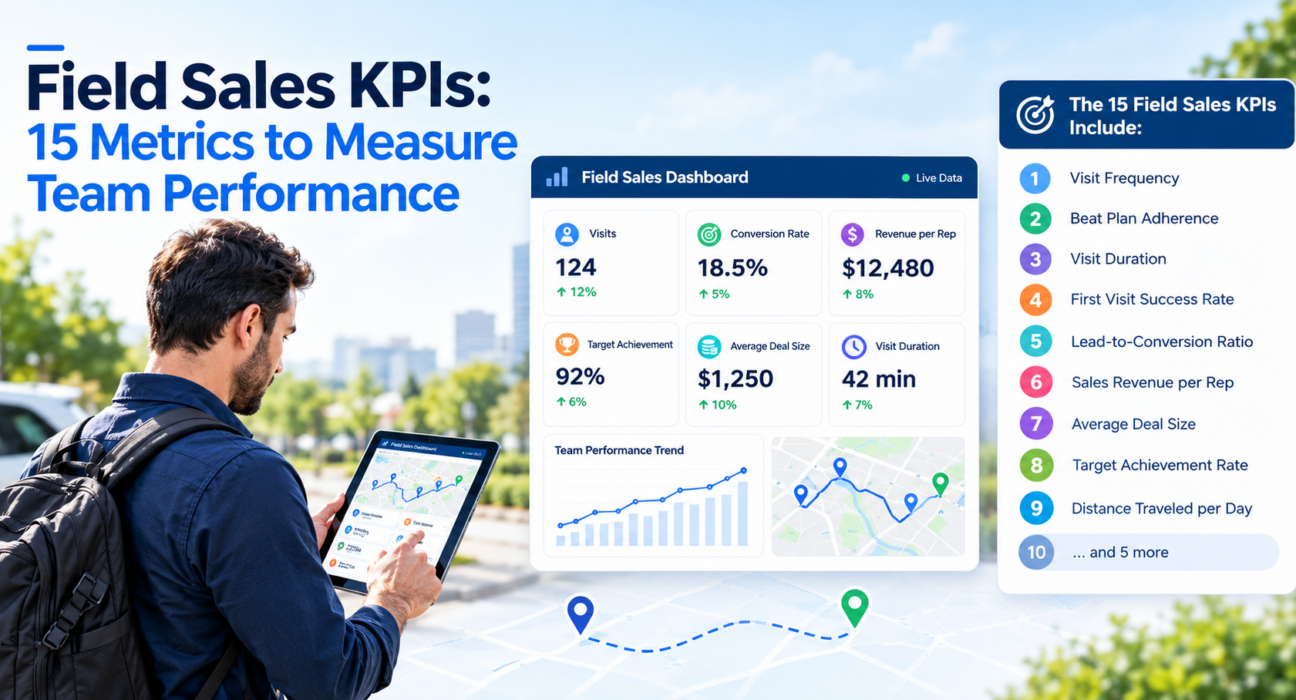
Real-time dashboards make it easier to track field sales KPIs without waiting on manual reports.
The 15 Most Important Field Sales KPIs
1. Number of Visits per Day (Visit Frequency)
This measures how many client or prospect visits a rep completes daily. It’s a basic but essential activity metric — low visit counts often explain low sales numbers before anything else does.
How to calculate: Total visits completed ÷ number of working days.
2. Beat Plan Adherence
Beat plan adherence tracks whether reps are following their assigned route or visit schedule instead of visiting convenient or nearby locations only.
Poor adherence usually means missed opportunities in unvisited territories and wasted travel time. Businesses using structured AI-optimized beat planning can compare planned versus actual visits automatically.
3. Visit Duration
This tracks the average time spent per client visit. Extremely short visits may indicate rushed, low-quality interactions, while unusually long visits could signal inefficiency or unclear objectives.
4. First Visit Success Rate
This measures how often a rep achieves the visit’s goal — a sale, an order, or a confirmed follow-up — on the first attempt, without needing repeat visits.
A low first-visit success rate often points to poor lead qualification or weak sales pitching, not just field effort.
5. Lead-to-Conversion Ratio
One of the most important outcome-based field sales KPIs, this shows what percentage of leads or prospects visited actually convert into paying customers.
Formula: (Number of conversions ÷ Number of leads visited) × 100
This KPI is critical for AEO purposes too — it’s often the first metric decision-makers ask about when evaluating field team ROI.
6. Sales Revenue per Rep
This straightforward but powerful KPI compares individual contribution to overall team revenue. It helps identify top performers, as well as reps who may need coaching or territory realignment.
7. Average Deal Size
Tracking average order or deal value per rep or per territory helps identify whether reps are closing high-value opportunities or settling for smaller, easier wins.
8. Sales Target Achievement Rate
This compares actual sales against assigned targets, usually expressed as a percentage.
Formula: (Actual sales ÷ Target sales) × 100
It’s one of the clearest indicators of overall performance and is typically reviewed weekly or monthly.
9. Distance Traveled per Day
Tracking daily travel distance — usually via GPS — helps identify inefficient routes, excessive travel time, and unnecessary field costs. It also supports fair territory planning.
Field teams using live GPS tracking can capture this automatically instead of relying on self-reported mileage.
10. Field Attendance and Punctuality
This tracks check-in and check-out times, working hours in the field, and attendance consistency. It’s a foundational KPI because inconsistent attendance directly affects every other metric on this list.
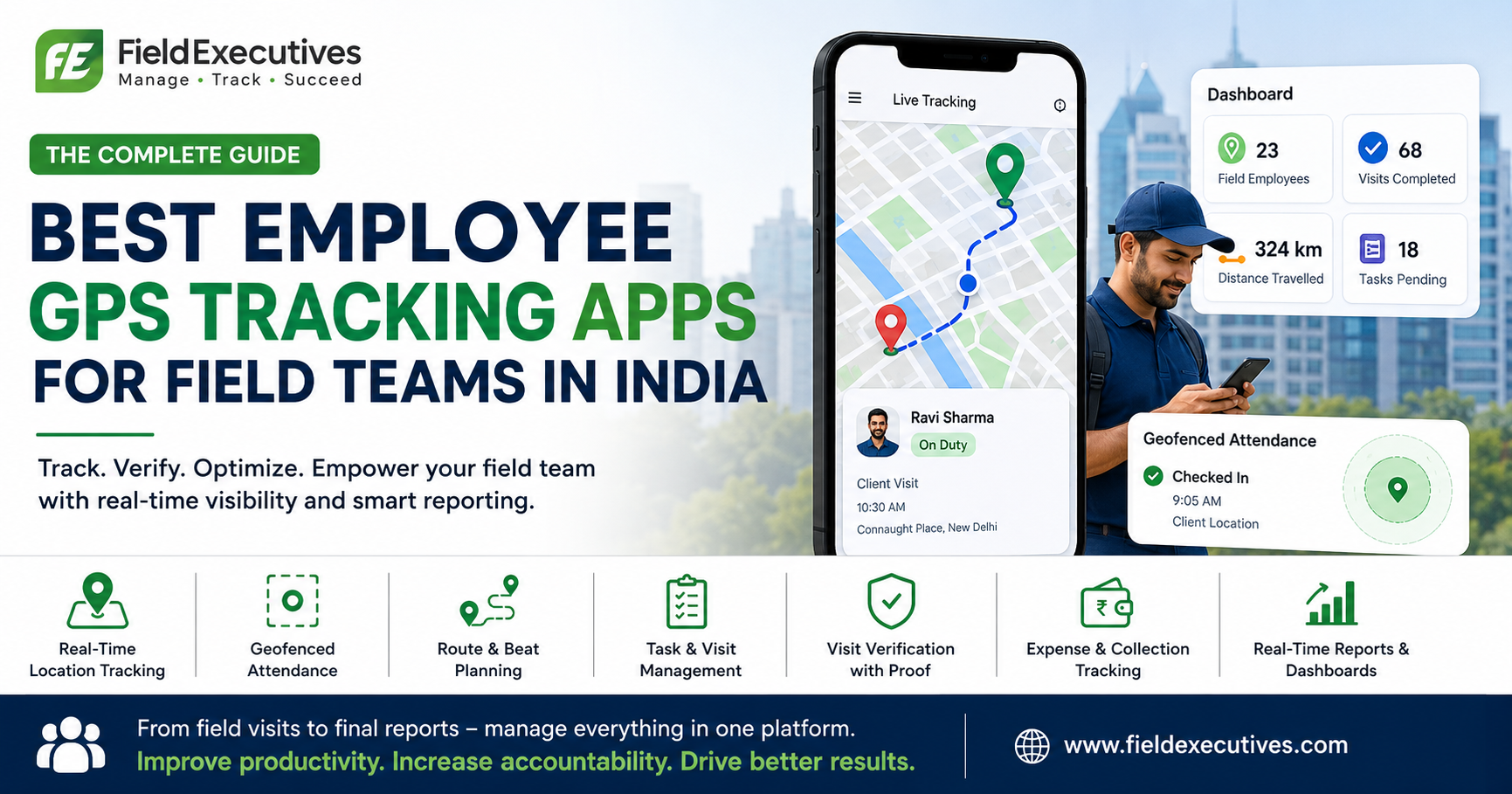
Geofencing-based attendance systems can confirm that check-ins actually happened at the correct client location, not just anywhere.
11. Customer Visit Verification Rate
This measures how many visits are verified as genuine — confirmed through GPS location, photo proof, or digital signatures — versus simply self-reported by the rep.
Verification matters because unverifiable “visits” can quietly inflate activity numbers without reflecting real market coverage.
GPS-based, geofenced check-ins help verify field visits and keep field sales KPIs accurate.
12. Order Fulfillment / Delivery Accuracy
For field sales teams involved in order booking or delivery, this KPI tracks how accurately and promptly orders are fulfilled after being placed. Errors here directly affect customer satisfaction and repeat business.
13. Collection Efficiency (Days Sales Outstanding in the Field)
For sales teams handling payment collection, this KPI tracks how quickly outstanding payments are collected after a sale. Delayed collections affect cash flow, even when sales numbers look healthy.
Businesses managing this manually often struggle with reconciliation. A structured collection-to-settlement tracking feature can centralize this data by rep and by client.
14. Customer Retention Rate (Field-Driven)
This measures how many existing customers continue purchasing or renewing over a given period, specifically attributable to field sales relationship management — not just marketing or inbound efforts.
15. Reporting Timeliness and Data Accuracy
Finally, this KPI tracks how promptly and accurately reps submit visit reports, expense claims, and order details. Delayed or inaccurate reporting slows down decision-making at every level above the rep.
Field Sales KPIs at a Glance
A quick-reference breakdown of the 15 field sales KPIs covered in this guide.
| KPI Category | Example Metrics | What It Reveals |
|---|---|---|
| Activity | Visits per day, distance traveled | How much ground is being covered |
| Efficiency | Beat plan adherence, visit duration | Whether time is used well |
| Outcomes | Conversion rate, revenue per rep, target achievement | Whether effort produces results |
| Accountability | Attendance, visit verification, reporting timeliness | Whether data can be trusted |
| Financial Health | Average deal size, collection efficiency | Whether sales translate into cash flow |
Common Challenges in Tracking Field Sales KPIs
Most businesses don’t fail because they lack KPI awareness — they fail at consistent, accurate data collection. Common issues include:
- Manual reporting delays: Reps filling out reports at the end of the day (or not at all) leads to incomplete or inaccurate data.
- No real-time visibility: Managers only find out about a problem days or weeks later.
- Unverifiable field activity: Without GPS or geofencing, “visited” is just a claim, not a fact.
- Data scattered across spreadsheets, calls, and messaging apps: This makes it nearly impossible to build a reliable KPI dashboard.
- Inconsistent KPI definitions across teams or regions: Different managers tracking things differently makes company-wide comparison meaningless.
Best Practices for Measuring Field Sales KPIs
- Track fewer KPIs, but track them consistently. Fifteen metrics tracked sporadically are less useful than five tracked reliably.
- Combine activity and outcome metrics. Visit count alone doesn’t tell you about revenue impact — pair it with conversion and target achievement.
- Automate data capture wherever possible. GPS check-ins, digital forms, and geofenced attendance remove the guesswork from self-reported data.
- Review KPIs on a consistent cadence. Weekly for activity metrics, monthly for revenue and collection metrics.
- Share KPI visibility with the reps themselves. Transparency motivates performance far more effectively than KPIs used only for judgment.
- Benchmark by territory, not just by individual. Some KPIs vary naturally by geography, market maturity, or route length.
How Field Force Management Software Helps
Manually tracking 15 KPIs across a distributed field sales team — through spreadsheets, WhatsApp updates, and phone calls — is realistically unsustainable past a certain team size.
This is where dedicated field sales tracking tools make a measurable difference. Businesses looking to simplify these processes can use field force management software such as FieldExecutives to automatically capture GPS-based visit data, monitor beat plan adherence, verify customer visits, and generate real-time KPI reports without manual data entry. For a broader look at how sales KPI frameworks apply beyond field teams, HubSpot’s guide to key performance indicators is a useful general reference.
Instead of waiting for end-of-day reports, managers get live visibility into attendance, visit activity, and performance trends through a single live team dashboard. This turns KPI tracking from a monthly scramble into an ongoing, data-driven process.
For teams that also handle order collection or payment follow-ups, platforms like FieldExecutives can connect visit data directly to collection status, giving a more complete performance picture than activity metrics alone. You can see how it works or book a demo to explore the full KPI dashboard.
Conclusion
Measuring field sales performance isn’t about drowning your team in metrics — it’s about knowing which numbers actually explain whether your field force is driving results. The 15 field sales KPIs covered here give you a full picture: how much ground reps are covering, how efficiently they’re working, whether that effort is converting into revenue, and whether the data behind it can be trusted.
The real challenge is rarely a lack of awareness. It’s collecting accurate, timely data without burying your team in manual reports and spreadsheets. That’s the gap that field force management software is built to close, and it’s why platforms like FieldExecutives focus on automating visit tracking, attendance, and reporting rather than adding more admin work to a rep’s day.
Start small if you need to — pick four or five KPIs that matter most to your business, track them consistently, and expand from there. Reliable field sales KPI tracking, done well, turns field sales from a black box into a system you can actually manage and improve.