

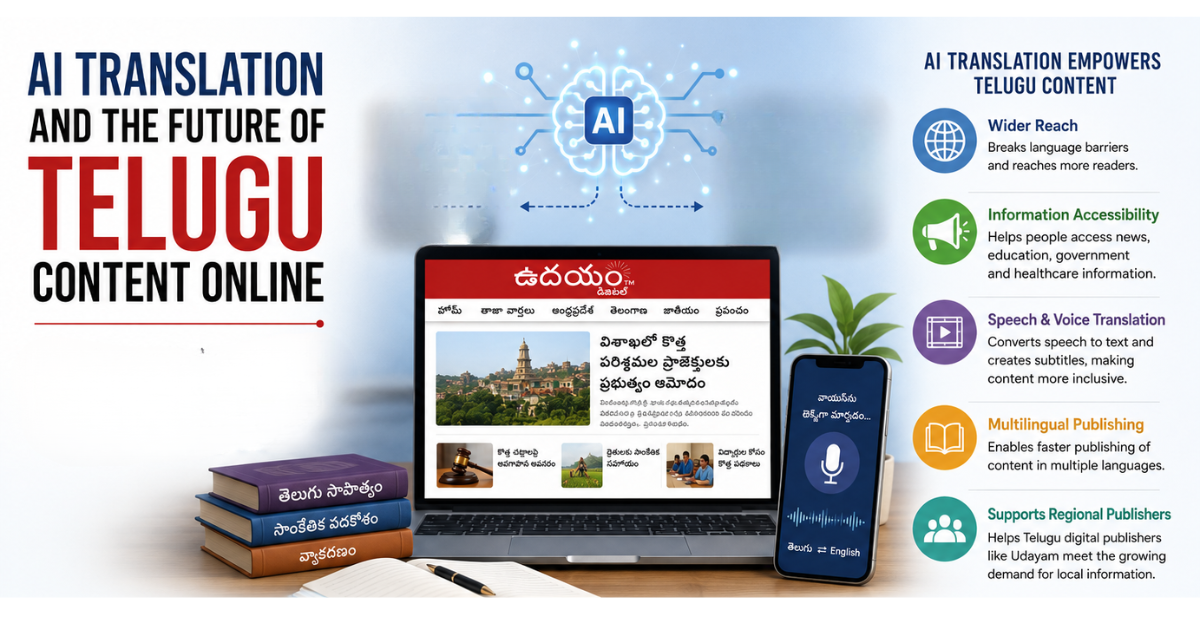
Artificial intelligence is transforming the way people create, translate, and consume digital content. As internet usage continues to grow across India, there is increasing demand for information in regional languages, particularly Telugu. AI-powered translation tools are helping bridge language gaps, making articles, educational resources, government information, and online services more accessible to millions of users.
However, while machine translation has made remarkable progress, it cannot fully replace original journalism or human expertise. The future of Telugu content online will likely combine AI efficiency with skilled editors and native-language writers to deliver accurate, culturally relevant, and trustworthy information.
The Growing Need for Telugu Content
India has one of the world’s largest multilingual internet populations. More users now prefer reading news, learning new skills, and accessing government services in their native language rather than English.
Businesses, educational institutions, media organizations, and public agencies are investing in Telugu content to better serve local audiences. This demand is encouraging the development of AI tools that can translate content more quickly while supporting broader access to information.
Challenges of Telugu Translation
Telugu is a rich and expressive language with complex grammar, sentence structures, and vocabulary. Translating accurately requires more than replacing one word with another.
Some common challenges include:
- Complex sentence construction
- Multiple meanings for similar words
- Regional dialects
- Idioms and expressions
- Grammar variations
- Honorific forms of speech
Even advanced AI models may struggle when translating content that contains local expressions or context-specific meanings.
Understanding Context and Cultural Nuance
One of the biggest challenges in AI translation is understanding context.
For example, the same Telugu word may carry different meanings depending on the topic, region, or tone of the conversation.
Cultural references, traditional sayings, festivals, and local customs often require interpretation rather than direct translation. Human editors remain essential for ensuring that translated content preserves its intended meaning while sounding natural to Telugu readers.
Formal Versus Conversational Telugu
Telugu is used differently depending on the audience and purpose.
Formal Telugu is common in:
- Government documents
- Academic publications
- Legal communication
- Official announcements
Conversational Telugu is preferred for:
- Social media
- Digital news
- Blogs
- Videos
- Mobile applications
AI translation systems must recognize these differences to produce content that matches the expectations of the intended audience. Choosing the appropriate style improves readability and user engagement.
Translating Technical Terminology
Technology, healthcare, finance, engineering, and science introduce new terminology every year.
Many technical terms do not have widely accepted Telugu equivalents, making translation difficult.
AI systems often need to determine whether to:
- Translate the term
- Transliterate it into Telugu script
- Retain the English word
- Use a descriptive explanation
Combining AI with domain experts helps ensure that technical content remains both accurate and easy to understand.
Human Editing Remains Essential
Although generative AI can significantly speed up translation, human review is still a critical part of the publishing process.
Editors help by:
- Correcting translation errors
- Improving sentence flow
- Preserving cultural meaning
- Verifying facts
- Maintaining consistency
- Adapting content for local readers
Human oversight is especially important for news, healthcare, legal information, and educational materials, where even small errors can lead to misunderstanding.
Speech Translation Is Expanding Access
Advances in speech recognition and AI translation are making spoken Telugu content more accessible.
Modern tools can:
- Convert Telugu speech into text
- Translate spoken conversations
- Generate subtitles automatically
- Create multilingual captions
- Support voice assistants
- Improve accessibility for hearing-impaired users
These technologies make it easier for people to access information across different languages and formats while improving the overall digital experience.
Improving News and Information Accessibility
AI translation can help publishers reach wider audiences by making information available in multiple languages more quickly.
However, translated news should not be viewed as a substitute for original reporting. Original journalism involves fact-checking, interviews, editorial judgment, and local context—elements that automated translation alone cannot provide.
As demand for authentic regional-language information grows, Telugu digital publishers continue to expand their online presence. Platforms such as Udayam Telugu News contribute original Telugu reporting for readers seeking timely regional updates, demonstrating the continued importance of native-language journalism alongside AI-powered translation technologies.
Risks of Mistranslation
Despite rapid improvements, AI translation is not perfect.
Potential risks include the following:
- Incorrect interpretation of context
- Misleading headlines
- Translation of idioms literally
- Confusing technical terminology
- Loss of cultural meaning
- Inaccurate public information
These challenges highlight why editorial review and quality assurance remain essential before publishing translated content.
The Future of Multilingual Publishing
The future of digital publishing is likely to combine artificial intelligence with human expertise rather than replacing one with the other.
AI will continue to automate repetitive tasks such as translation, transcription, subtitle generation, and multilingual publishing. Human writers, editors, and journalists will remain responsible for creating original content, verifying facts, refining language, and ensuring cultural relevance.
This collaborative approach will help publishers deliver faster, more accessible, and higher-quality information to diverse audiences while preserving the authenticity and richness of regional languages like Telugu.
Conclusion
AI translation is opening new possibilities for expanding Telugu content online and improving access to information for millions of users. While machine translation continues to become more accurate, it works best as a tool that supports—not replaces—human expertise.
The future of Telugu digital publishing will depend on combining AI-driven efficiency with original journalism, professional editing, and cultural understanding. By balancing automation with editorial quality, publishers can create trustworthy multilingual experiences that serve readers across India and beyond.