
Call Recording for Sales Teams: How It Improves Performance (and How to Do It Right)
A customer says, “Your agent promised me a discount.” The agent says, “I never said that.” Without a recording, nobody can settle it. The same gap affects coaching: a manager hears two or three calls a week and has to guess how the rest sound.
Using call recording for sales teams fixes both problems. It gives managers real conversations to learn from and gives the business a reliable record. This guide explains how recording improves performance, how to run a simple review programme and what to check on privacy before you start.
What Is Call Recording for Sales Teams?
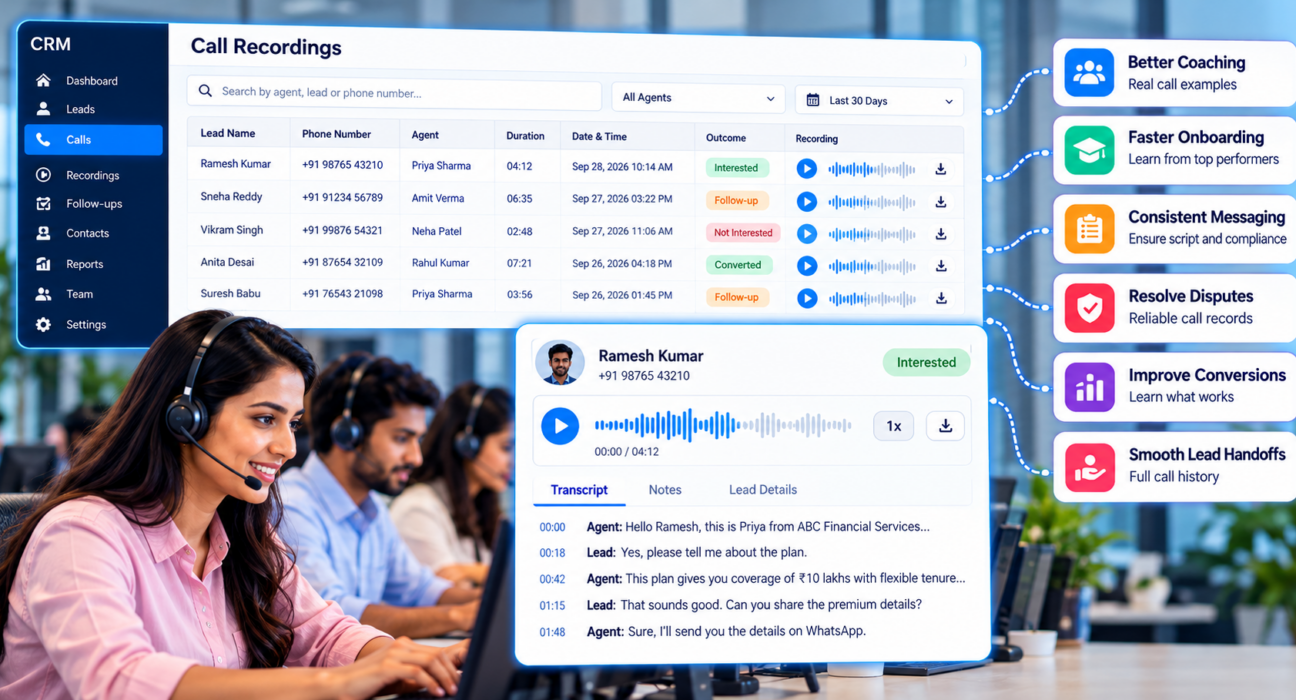
Call recording for sales teams means saving sales calls, with the lead’s details and call outcome, so managers can review them for coaching, quality and compliance. In a CRM, each recording sits on the lead’s timeline next to notes, outcomes and follow-ups, so anyone with access can understand the full history.
Why Coaching Without Recordings Falls Short
Most sales managers face the same limits:
- They hear only a small fraction of calls, often by sitting next to an agent
- Agents behave differently when they know they are being watched
- Feedback depends on memory, not evidence
- New agents learn slowly because they cannot hear good calls
- Disputes about promises, prices or terms become one person’s word against another’s
Recording removes the guesswork. A manager can listen at a convenient time, pick the calls that matter and play the exact moment when a call went well or badly.
7 Ways Call Recording Improves Sales Team Performance
1. Coaching with real examples
Telling an agent “handle objections better” helps little. Playing a 30-second clip where an objection was dropped helps a lot. Real examples make feedback specific and easier to act on.
2. Faster onboarding
New agents can listen to calls from experienced colleagues before they start dialing. They learn tone, pacing and how to answer common questions.
3. Consistent messaging
Recordings show whether agents follow the script, state key terms correctly and make required disclosures. This matters in regulated areas such as loans and insurance.
4. Quicker dispute resolution
When a customer disputes what was said, the recording is the reference. It protects both the customer and your team from misunderstandings.
5. Learning from top performers
If one agent converts more than others, listen to their calls. You may find a better opening, sharper questions or a clearer next step that others can copy.
6. Stronger follow-ups
Agents can replay a call to recall what the customer asked for, and managers can check that the promised callback was actually scheduled.
7. Better lead handoffs
When a lead moves between agents, the new agent can listen to earlier calls and carry on without repeating questions.
Manual Review vs AI Call Analysis
Manual review is valuable, but a manager cannot listen to every call. Some tools add automatic transcription, summaries, sentiment and quality scores to help you decide which calls to review first.
These tools can save time, but treat their scores as a guide. A low score is a reason to listen, not a final verdict on an agent. Check how accurate transcription is for the languages your team uses, such as Hindi and Hinglish.
How to Run a Simple Call Review Programme
- Set a sample. Review three to five calls per agent each week, including some short, long, converted and lost calls.
- Use a scorecard. Score every call on the same few points, so feedback is fair and comparable.
- Give feedback within a few days. Play one good moment and one improvement area, then agree on one action.
- Share good calls. Build a small library of best calls for training.
- Track progress. Look at scores, connect rate and conversion over time, and revisit weak areas.
A sample scorecard
| Area | What to check | Score (1–5) |
|---|---|---|
| Opening | Clear introduction and reason for the call | |
| Discovery | Relevant questions, active listening | |
| Product explanation | Accurate, simple and tied to the customer’s need | |
| Objection handling | Calm, honest and specific | |
| Next step | A clear follow-up or action agreed | |
| Compliance | Required disclosures and consent followed |
Adjust the areas to your business, and keep the scorecard short enough to use.
Example: An Insurance Team (Hypothetical)
This is a hypothetical example. An insurance team notices that renewal conversions vary widely between agents. The manager reviews a sample of recorded calls and finds that weaker calls skip a clear explanation of the renewal benefits and end without a date for the next call.
The team adds a short checklist and trains agents on a better closing. The manager then reviews calls again after a few weeks to see if the pattern has changed. Recording did not fix the problem on its own, but it showed exactly where to look.
Privacy, Consent and Retention
Recordings contain personal data, so handle them with care. India has no single dedicated call-recording law, and the position depends on several laws and on how you use the data. Sources commonly advise telling callers that calls may be recorded, and stating the purpose.
India’s Digital Personal Data Protection Act, 2023, published by MeitY, generally requires organisations to erase personal data once the purpose is served or consent is withdrawn, unless the law requires retention. Good practice includes:
- Telling callers early that the call may be recorded, and why
- Limiting who can listen, so agents hear only their own calls
- Storing recordings securely, with encryption
- Setting a retention period and deleting recordings when no longer needed
- Using recordings only for the stated purpose, such as quality and training
- Telling employees how recordings are used
Rules on recording and consent change, so confirm your approach with a legal adviser.
What to Look for in Call Recording Features
If you are choosing a CRM for recorded calls, check these points during a trial:
- Automatic recording: recordings should attach to the right lead without manual uploads.
- Easy playback: managers should find and play a call in a few clicks.
- Access control: agents, managers and admins should see only what their role needs.
- Security: ask how recordings are stored and transmitted.
- Retention settings: you should be able to set how long recordings are kept.
- Search and filters: filter by agent, date, outcome or duration.
- Mobile behaviour: test recording on the phones your agents actually use.
Common Mistakes With Call Recording
- Recording without a plan. Recordings that nobody reviews have little value.
- Using recordings only to catch mistakes. This damages trust, so also share good calls.
- Skipping disclosure. Transparency protects your customers and your business.
- Keeping everything forever. Old recordings add privacy risk and storage cost.
- Giving everyone access. Restrict access by role.
- Relying only on AI scores. Combine automation with human judgement.
- Reviewing randomly with no scorecard. Without a standard, feedback feels unfair.
How TeleCallingCRM Supports Call Recording and Review
TeleCallingCRM is built for outbound calling teams. According to its website, it includes:
- Call recording, stored encrypted and played back through authenticated access from the lead’s timeline
- Role-based listening, where agents hear only their own calls and admins can hear the whole team
- Configurable retention, with automatic purging of recordings and closed leads
- DNC enforcement and a calling-hours window
- Stage-aware call scripts shown on the call screen
- AI call analysis, which can be enabled to transcribe English, Hindi and Hinglish calls and produce summaries, sentiment, action items and a 0–100 quality score with coaching notes
- A live war room and reports for tracking team activity
The site lists plans from ₹999 per month and a 3-day free trial, so you can test recording and review with a few agents first. See the pricing page for current details. For an industry view, read how insurance teams use a telecalling CRM. The AI features are described as optional, so check that they suit your needs.
Frequently Asked Questions
How does call recording improve sales performance?
It lets managers coach with real examples, helps new agents learn from good calls, resolves disputes and shows what top performers do differently. The improvement comes from reviewing and acting on recordings, not from recording alone.
Is call recording legal in India?
India has no single dedicated call-recording law, and the position depends on several laws, including data protection rules. It is common practice to tell callers that calls may be recorded and why. Confirm your setup with a legal adviser.
Should customers be told that a call is being recorded?
Telling them is good practice, and many businesses do it at the start of the call. State the purpose, such as quality and training, and use the recording only for that purpose.
How many calls should a manager review?
There is no fixed number. A common starting point is three to five calls per agent each week, including both wins and losses. Increase the sample for new agents.
How long should call recordings be stored?
Keep them only as long as you need them for your stated purpose or legal requirements. Set a retention period, and delete or purge recordings after it ends. Ask your legal adviser what applies to your sector.
Can AI replace manual call review?
No. AI can transcribe, summarise and flag calls, which saves time. Managers should still listen to calls, especially those flagged as low-scoring, before giving feedback.
Conclusion
Call recording for sales teams works best when it is paired with a simple review routine, a fair scorecard and clear privacy rules. Used this way, it helps managers coach with evidence, helps new agents learn faster and gives your business a reliable record.
If you want to see how this works in a calling workflow, you can book a demo of a CRM for telecallers and test recording with your own team.