
Best CRM Software for Sales Teams in India: A Practical Buying Guide
Most Indian sales teams don’t struggle because they lack leads. They struggle because leads sit in WhatsApp chats, Excel sheets and a telecaller’s personal notebook, and nobody follows up on time. That’s usually the moment a sales manager starts searching for sales CRM software.
This guide walks through what actually matters when choosing a CRM for a sales team in India, how to compare options, and which mistakes to avoid. If your team spends most of its day on outbound calls, you may find it useful to look at lead management software built specifically for calling-heavy sales, rather than a generic CRM retrofitted for it.
What Is the Best CRM Software for Sales Teams in India?
The best sales CRM software for an Indian sales team is one that fits how the team actually sells. For most B2C and B2B teams here, that means heavy phone calling, WhatsApp follow-ups, and leads coming from multiple sources like Facebook ads, portals, and referrals. A good CRM should track every lead, log every call, and make follow-up nearly automatic, without a steep learning curve or a high per-user price tag.
There is no single “best” CRM for every business. A real estate agency, an insurance agency and a B2B SaaS company all sell differently, so the right CRM depends on your team size, sales process and budget.
Why Generic CRMs Often Fall Short for Indian Sales Teams
Many sales teams start with a spreadsheet, move to a generic CRM, and still feel something is missing. This usually happens because generic CRMs are built around email and web forms, not phone-first selling.
Common gaps include:
- No built-in dialer, so agents dial manually from a phone or laptop
- Weak follow-up reminders, so callbacks get missed
- Limited visibility into how many calls each agent actually made
- No easy way to catch duplicate leads or Do Not Call (DNC) numbers
- Pricing per user that gets expensive fast as the team grows
If your team’s day revolves around dialing, logging outcomes and following up, this gap between “CRM” and “how we actually sell” is the real problem to solve.
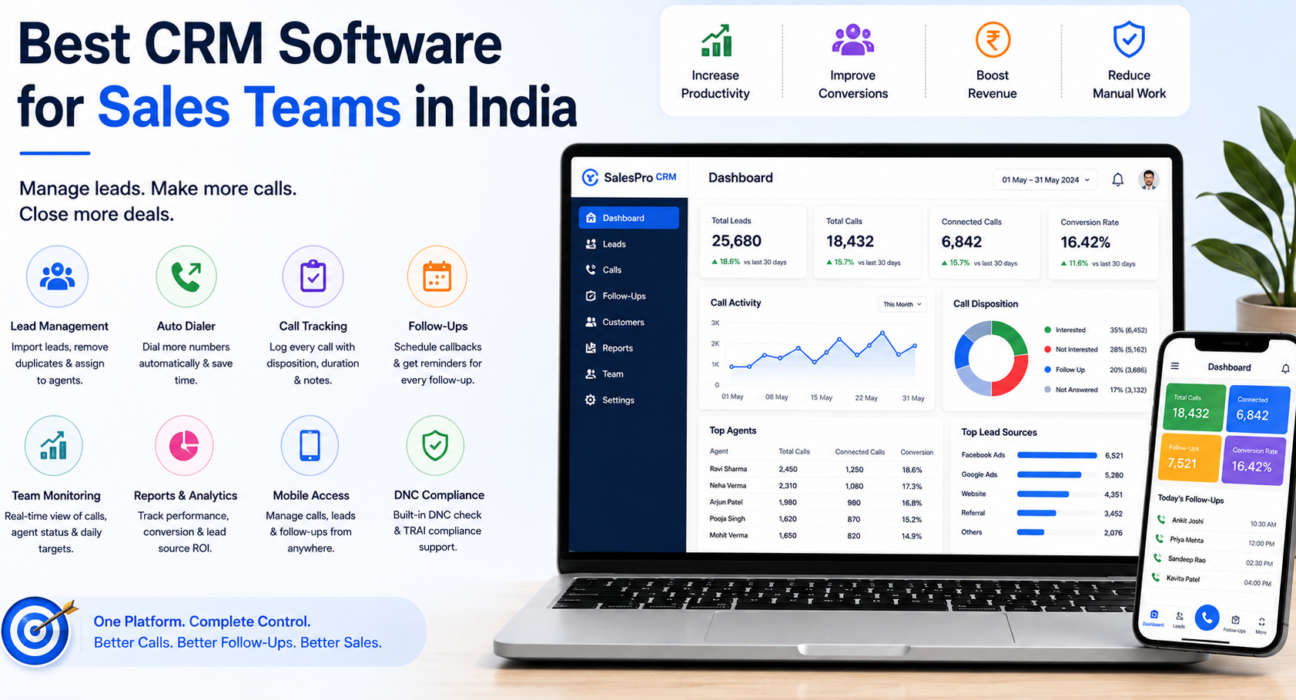
What to Look For in Sales CRM Software
Before comparing tools, it helps to have a checklist. These are the features that matter most for a calling-driven sales team in India.
1. Lead Management and Import
The CRM should let you import leads from a CSV, a portal, or an ad platform in minutes, not hours. It should also flag duplicate numbers automatically, so two agents don’t call the same person.
2. Calling and Dialing Support
Sales calling software with an auto dialer removes manual dialing and lets agents move from one lead to the next without wasting time. Every call should be logged automatically with duration, outcome and notes.
3. Follow-Up and Reminder System
A large share of lost deals come from missed follow-ups, not rejected pitches. Look for lead follow-up software that schedules callbacks automatically and alerts agents (and managers) when a follow-up is overdue.
4. Team Visibility and Reporting
Sales managers need to see, in real time, who is calling, who is idle, and which leads are going cold. Reports on connection rate, talk time and conversions help managers coach the team instead of guessing.
5. Compliance (DNC and TRAI)
Calling a number on the Do Not Call registry can lead to complaints and penalties. A CRM built for India should support DNC list management out of the box.
6. Mobile Access
Field agents, franchise teams and remote sales reps need to call, log outcomes and check follow-ups from a phone, not just a desktop dashboard.
7. Integrations with Lead Sources
If your leads come from Facebook Ads, Google Ads, property portals like 99acres or MagicBricks, or a website form, the CRM should pull them into one pipeline automatically instead of requiring manual copy-paste.
8. Pricing That Scales Sensibly
Many CRMs charge per user, which becomes costly as a team grows from 5 to 20 agents. Flat, team-based pricing is often more predictable for Indian small and medium businesses.
Telecalling CRM vs Generic CRM: What’s the Difference?
This is a common point of confusion, since both are sold as “sales CRM software.”
| Aspect | Generic CRM | Telecalling CRM |
|---|---|---|
| Core workflow | Email, deals, contact records | Calling, lead follow-up, agent activity |
| Dialing | Usually needs a separate dialer add-on | Built-in auto dialer |
| Best suited for | Long B2B sales cycles, account management | High-volume outbound calling teams |
| Team monitoring | Basic activity logs | Live call and agent monitoring |
| Compliance (DNC) | Often not included | Usually built in |
| Pricing model | Frequently per user | Often flat, team-based plans available |
A telecaller CRM is essentially a CRM designed around the phone call as the primary sales action, rather than treating calling as an afterthought.
How Different Industries Use Sales CRM Software
These are illustrative examples of how a calling-focused CRM can support different Indian industries. They are not case studies or customer results, just common use patterns.
- Real estate: Agents receive leads from portals like Housing.com or MagicBricks, and the CRM auto-assigns each lead to a free agent for a callback.
- Education: Admission counsellors follow up with enquiries from ads and website forms, with reminders that reduce no-response leads during peak admission season.
- Insurance: Agents track renewal dates and policy follow-ups, with call recordings kept for compliance and training.
- Recruitment: Recruiters manage candidate call-backs and status updates across multiple open roles at once.
- Finance and lending: DSAs and loan officers track document follow-ups and callback schedules for each applicant.
Benefits of Using the Right Sales CRM Software
- Fewer missed follow-ups, since reminders and overdue alerts do the remembering
- Faster response to new leads, which usually improves conversion since faster responses tend to convert better
- Clear visibility for managers, without needing to ask agents for manual updates
- Less time on manual dialing, so agents spend more time actually talking to prospects
- Centralised lead data, so leads don’t disappear when an agent leaves the company
Common Mistakes When Choosing a Sales CRM
- Picking a CRM built for a different sales motion. A tool designed for email-based B2B sales may not fit a high-volume calling team.
- Ignoring per-user pricing at scale. A plan that looks affordable for 5 users can become expensive at 20.
- Skipping the trial period. Agents should actually try dialing and logging calls before the team commits.
- Underestimating training time. A CRM that’s too complex often gets used inconsistently, which defeats its purpose.
- Forgetting compliance features. DNC violations can create real business risk, not just inefficiency.
- Choosing based on features alone. A long feature list means little if agents find the interface confusing on day one.
How TeleCallingCRM Fits Into This
For sales teams whose work is primarily calling-based, TeleCallingCRM is built specifically around that workflow. It combines a smart auto dialer, lead management, follow-up scheduling, real-time team reporting and a mobile app in one platform, with lead integrations from sources like Facebook and Instagram Lead Ads, Google Ads, and property portals such as 99acres, Housing.com and MagicBricks.
It also includes DNC list management, call tracking, and industry-specific setups for sectors like real estate, insurance, education and recruitment. This is useful context if you’re evaluating CRM for telecallers rather than a general-purpose sales CRM, but it’s worth comparing it against your own team’s workflow before deciding.
Frequently Asked Questions
What is the best CRM software for a small sales team in India?
For small, calling-focused teams, a telecalling-first CRM with an auto dialer, lead import and follow-up reminders is usually more practical than a generic CRM, since it fits the actual day-to-day workflow of outbound selling.
Is a telecalling CRM different from a regular sales CRM?
Yes. A regular CRM manages contacts and deals generally, while a telecalling CRM is built around calling as the core activity, with features like auto dialing, call logging and DNC compliance built in from the start.
Do I need an auto dialer for my sales team?
If your agents make a high volume of outbound calls each day, an auto dialer saves significant time by removing manual dialing between calls, letting agents focus on conversations instead of number entry.
How much does sales CRM software cost in India?
Pricing varies widely. Some CRMs charge per user, which adds up as a team grows, while others offer flat, team-based plans. It’s worth calculating the total cost at your expected team size, not just the starting price.
Can a sales CRM help with lead follow-up?
Yes, that’s often the biggest practical benefit. Good lead follow-up software schedules callbacks automatically and flags overdue leads, which reduces the number of prospects that get forgotten.
Is CRM software useful for small businesses, or only large teams?
CRM software helps at almost any team size once leads start coming from more than one source, since spreadsheets and personal notes become hard to track and follow up on consistently.
What industries benefit most from a telecalling CRM?
Industries with high call volumes and follow-up-heavy sales cycles, such as real estate, insurance, education, recruitment and financial services, tend to see the most day-to-day benefit from a calling-focused CRM.
Conclusion
Choosing sales CRM software isn’t about picking the tool with the longest feature list. It’s about matching the CRM to how your team actually works, whether that’s high-volume calling, long B2B sales cycles, or a mix of both. Start with a clear list of what your team needs daily, try a short trial with real leads, and see how it performs before committing.
If your sales process is built around outbound calling and follow-ups, it’s worth trying sales calling software designed for that workflow rather than adapting a generic CRM to fit.