
How to Manage Beat Plans for FMCG Sales Representatives (and Where FMCG Beat Planning Software Helps)
A beat plan decides which outlets each sales representative visits, on which day, and in what order. When it is built well, every retailer gets regular coverage and reps spend their day selling. When it is built badly, some outlets are visited three times a week, others are forgotten, and nobody can prove which is which.
Most FMCG teams still run beats on spreadsheets, paper route cards and WhatsApp messages. That works for five reps. It breaks at fifty. This guide explains how to design and manage beat plans, what usually goes wrong, and how FMCG beat planning software gives managers control over daily coverage.
What Is a Beat Plan in FMCG?
A beat plan is a pre-defined schedule of outlet visits assigned to a sales representative. It covers a fixed geographic area, repeats on a set cycle (usually weekly or fortnightly), and lists the retailers, wholesalers or distributors the rep must visit each day.
Beat plans are also called journey cycle plans (JCP) or route plans. The goal is to make sure every outlet gets the right visit frequency, based on its size and potential.
A typical beat plan defines:
- The territory: the area, pin codes or clusters assigned to the rep
- The outlet list: retailers, wholesalers and sub-distributors in that territory
- Visit frequency: weekly, fortnightly or monthly, by outlet category
- The sequence: the order of stops within a day
- The tasks at each stop: order booking, stock check, shelf audit, collection or display check
Why Beat Plan Management Matters
Beat planning sits at the centre of FMCG sales execution. The market runs on repeat visits to a large number of small outlets, so small inefficiencies add up quickly.
Poor beat management usually shows up as:
- Coverage gaps: outlets with real demand are visited rarely or never
- Overlap: two reps, or a rep and a distributor’s salesman, visit the same outlet
- Wasted travel: unplanned routes with backtracking and long gaps between stops
- Unverifiable visits: reports based on what the rep says, not what the system shows
- Slow course correction: managers find out about missed visits days later
How to Manage Beat Plans for FMCG Sales Representatives: Step by Step
Follow these six steps to build and run an effective beat plan.
- Map and clean your outlet universe. List every outlet in the territory with its address, category and location. Remove duplicates and closed outlets before you plan anything.
- Segment outlets by potential. Group outlets into classes (for example A, B and C) using sales volume, outlet size or strategic importance. This decides visit frequency.
- Set visit frequency by segment. High-potential outlets get more frequent visits. Low-potential outlets can be covered less often or by the distributor.
- Cluster outlets geographically. Group nearby outlets into daily beats so a rep covers a compact area instead of crossing the territory.
- Define the work per visit. Decide what a productive call means for each outlet type, such as an order, a stock check or a display audit. Reps should know the goal before they walk in.
- Track, review and rebalance. Compare planned and actual visits every week. Adjust beats when outlets open or close, when a rep leaves, or when workload is uneven.
Choose Visit Frequency by Outlet Value
A simple frequency framework looks like this. Treat it as a starting point, then tune it to your category and market.
| Outlet class | Typical profile | Example visit cycle |
|---|---|---|
| A | High-volume, strategic outlets | Weekly or more often |
| B | Mid-volume regular outlets | Fortnightly |
| C | Low-volume or distant outlets | Monthly or via distributor |
Balance Workload Across Reps
An even beat is not one with the same number of outlets. Account for outlet class, travel distance and the time each visit needs. A rep with fifteen small outlets close together may carry less load than one with eight spread across a district.
Common Beat Plan Problems in FMCG Field Sales
The most common beat planning problems are stale outlet data, unequal workloads, unverified visits and no real-time visibility. Here is how each one plays out.
Stale outlet data
Outlets open, close and change hands. A beat built on last year’s list sends reps to shuttered shops and misses new ones.
Unverified visits
If a visit is recorded only when a rep reports it, managers cannot tell a real visit from a claimed one. This hurts coaching, incentives and trust.
Manual routing
Reps often choose their own sequence. That can mean extra kilometres, missed time windows and uneven coverage across the week.
Delayed reporting
When updates arrive by phone call or end-of-day message, managers cannot step in while there is still time to recover a missed visit.
Rigid plans
Real days change: a shop is closed, a priority order comes in, a rep is on leave. Beat plans that cannot adapt get ignored.
What Is FMCG Beat Planning Software?
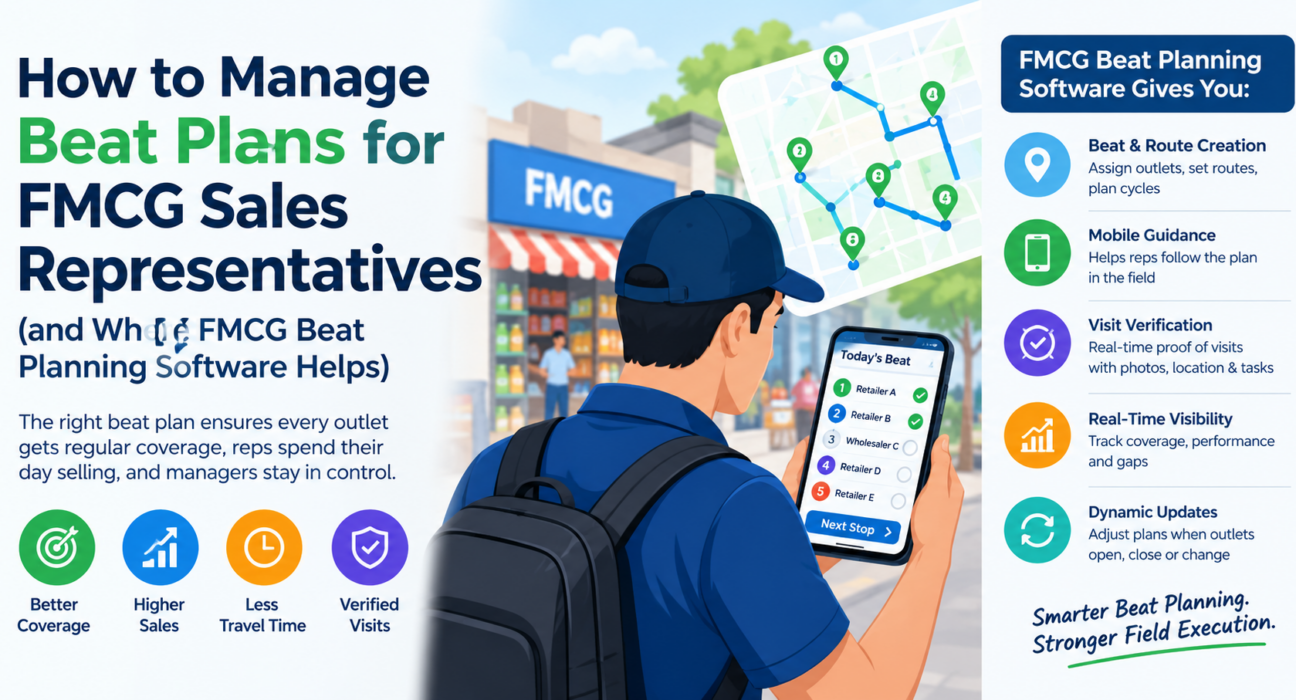
FMCG beat planning software is a mobile and web platform that assigns outlet visits to sales reps, guides them through the route, verifies each visit and shows managers coverage in real time. It replaces spreadsheets and chat-based coordination with one system of record.
Good beat planning software usually combines:
- Beat and route creation: assign outlets to reps and days
- Route optimisation: order stops to reduce travel
- GPS and geofencing: confirm the rep was actually at the outlet
- Proof of visit: photo, signature or OTP at the stop
- Custom forms: capture stock, orders, audits or surveys at each visit
- Offline capture: work in patchy network areas and sync later
- Dashboards and reports: planned versus actual visits, coverage and productivity
Benefits of Using FMCG Beat Planning Software
The main benefits are better outlet coverage, lower travel time, verified visits and faster decisions.
- Consistent coverage: every outlet is visited on its planned cycle, and misses are visible the same day
- Less wasted travel: optimised sequences reduce backtracking between stops
- Reliable data: visits are time-stamped, location-verified and tied to proof
- Faster management action: managers see who is behind and can reassign or follow up quickly
- Easier coaching: objective data on visits, time at outlet and outcomes shows which reps need support
- Less admin: no manual route cards, call-ins or end-of-day reconciliation
Beat Planning: Spreadsheets vs Software
| Factor | Spreadsheets and WhatsApp | FMCG beat planning software |
|---|---|---|
| Visit verification | Rep’s word | GPS, geofence and proof of visit |
| Route sequencing | Manual or rep’s choice | Optimised sequence |
| Manager visibility | Delayed | Live |
| Plan changes | Re-send and re-explain | Update and sync to the rep’s phone |
| Coverage reporting | Manual compilation | Automatic reports |
| Scalability | Breaks as team grows | Handles larger teams on one system |
Best Practices for Running Beat Plans
- Review outlet lists every month. Add new outlets and retire inactive ones.
- Keep beats compact. Short hops between stops mean more time selling.
- Set a clear goal per visit. An outlet visit with no objective is easy to waste.
- Measure the right things. Track visit compliance, productive calls and outlet coverage, not only total visits.
- Leave room for the unexpected. Build in time for urgent requests and closed shops.
- Use data in coaching. Walk through planned versus actual with each rep weekly.
- Re-balance beats on a schedule. Do it quarterly, or whenever team size or territory changes.
How FieldExecutives Supports FMCG Beat Planning
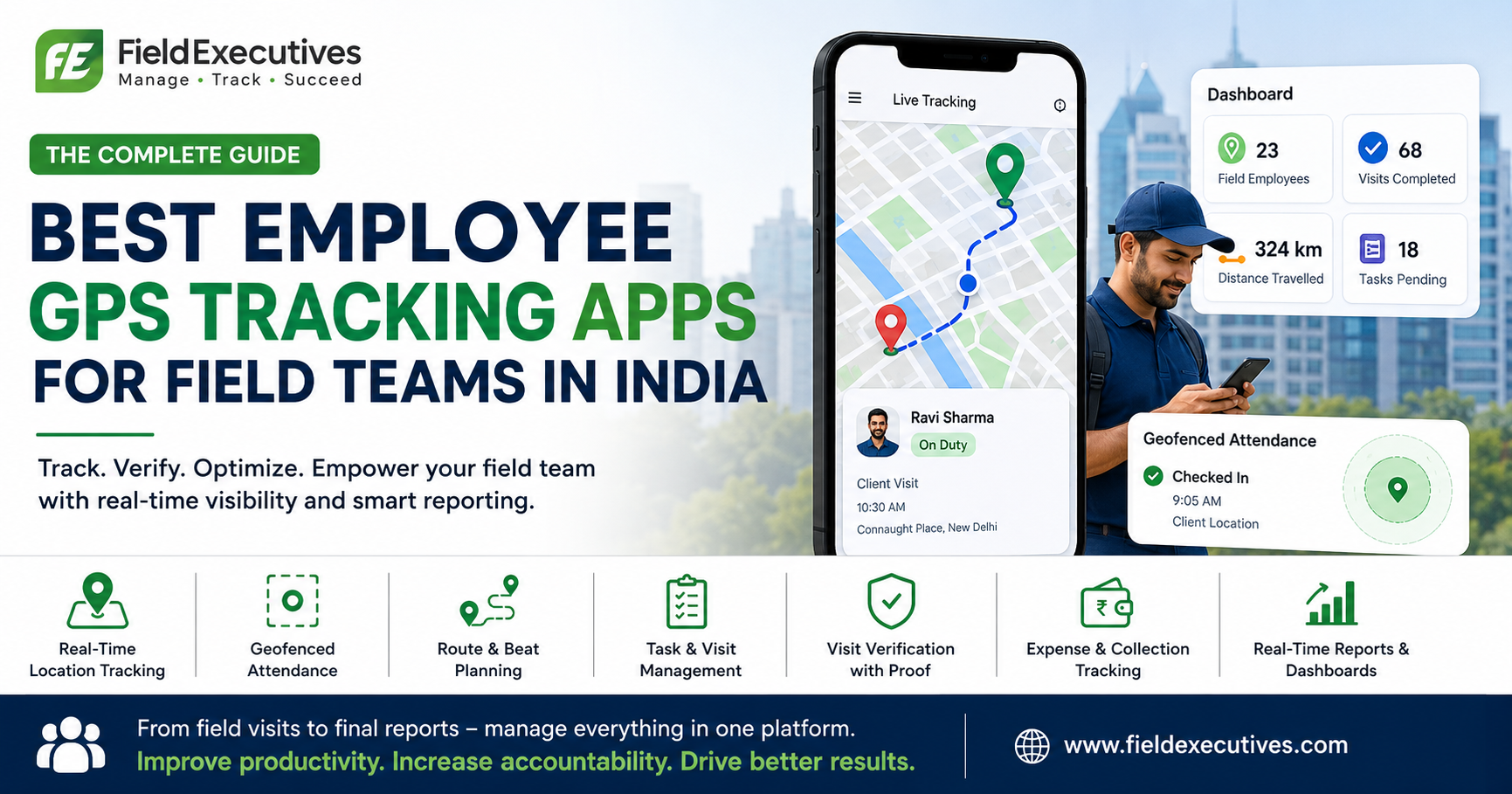
Businesses looking to simplify these processes can use field force management software such as FieldExecutives, which includes an FMCG and distribution solution built around beat plans, orders and coverage.
Based on the FieldExecutives website, the platform supports:
- AI beat-plan and route optimisation: FieldExecutives states that optimised beat plans and route ordering can reduce travel time by 20–30%. The site describes this figure as illustrative, not a guarantee, so results will vary by territory.
- Live map and GPS trail: see where reps are and the path they took
- Geofenced attendance and auto check-in: punch-ins use server time, geofencing and spoof detection
- Proof of visit: photo, signature or OTP capture before a job closes
- Custom forms and workflows: build forms for the data each visit needs, without code
- Offline-first mobile app: reps can work without a network and sync later
- Real-time KPIs and reports: leaderboards and dashboards for managers
- Expense and collection tracking: claims with receipts and field collections tracked to settlement
Pricing on the site is a flat monthly plan by team size with all features included, and a 7-day free trial is offered. Check the pricing page for current plans.
How to Choose FMCG Beat Planning Software
Use this checklist when you evaluate options:
- Can it assign and modify beats by rep, day and outlet?
- Does it verify visits with GPS and proof, not just self-reporting?
- Does it work offline in low-network markets?
- Can you build custom forms for orders, stock or audits?
- Does it show planned versus actual coverage in real time?
- Is it easy for reps to use on standard phones?
- Does it integrate with your existing CRM, ERP or accounting tools?
- Is the pricing predictable as your team grows?
Run a pilot with one team before a full rollout. Compare visit compliance, coverage and travel time against your current process.
Conclusion
Beat plans decide how well your brand shows up at the outlet. Segment outlets, set visit frequencies, cluster routes, define the work per call and review actual against planned every week. When your team grows past what spreadsheets and chat groups can handle, FMCG beat planning software gives you verified visits, live visibility and routes that waste less time.
FieldExecutives brings beat plans, GPS tracking, proof of visit and reporting into one platform for field sales teams. Start with a small pilot and measure what changes.