

Regulatory compliance is not getting easier for manufacturers. Requirements continue to expand across jurisdictions, enforcement has intensified, and the documentation standards regulators expect have become more rigorous. At the same time, manufacturers are operating more complex global supply chains, managing more product variants, and facing faster production cycles that make compliance oversight harder.
For manufacturing leadership, the challenge is not whether to comply with regulations. That is not optional. The challenge is building compliance infrastructure that scales with your operations, provides reliable evidence when regulators ask for it, and does not create so much administrative overhead that it slows down production or consumes quality resources that should be focused on prevention.
Many manufacturers are managing regulatory compliance with systems that were adequate ten years ago but are struggling under current demands. Manual processes, disconnected systems, and site-specific approaches to compliance create gaps that regulators find and that leadership discovers only when enforcement actions arrive. The cost of these gaps is measured not just in fines, but in production delays, market access restrictions, and reputational damage that affects customer relationships and shareholder confidence.
This article explains what manufacturing leaders need to understand about the relationship between quality management systems and regulatory compliance, why this becomes more complex at enterprise scale, and what it takes to build compliance infrastructure that actually reduces risk rather than just documenting it.
Why Regulatory Compliance Depends on Your QMS
For regulated manufacturers, your quality management system is your compliance system. Regulators do not just want to see that you are producing safe, effective products. They want evidence that you have systematic processes for ensuring quality, that you follow those processes consistently, and that you continuously monitor and improve them.
This means regulatory inspections are fundamentally QMS audits. Regulators review your procedures, examine your training records, investigate your CAPAs, trace your materials, analyze your complaints, and verify that your document control is working. They want to see that your quality system is functioning as designed and generating reliable evidence of compliance.
When your QMS is manual, fragmented, or inconsistent across sites, producing this evidence is difficult. Quality teams spend weeks preparing for inspections by manually compiling records from multiple sources, reconstructing documentation that should have been maintained systematically, and explaining process variations that exist because different sites implemented quality management differently.
The larger and more complex your manufacturing operations, the harder this becomes. A single-site manufacturer with one product line can manage compliance with relatively simple systems. A global manufacturer with dozens of facilities, hundreds of products, complex supply chains, and operations across multiple regulatory jurisdictions cannot. The volume and complexity of compliance evidence required exceeds what manual or fragmented systems can reliably produce.
This is why modern, integrated QMS platforms have become essential infrastructure for regulated manufacturers at scale. They provide the systematic evidence generation, traceability, and process consistency that regulators expect and that manual systems cannot deliver reliably.
The Scale Problem in Manufacturing Compliance
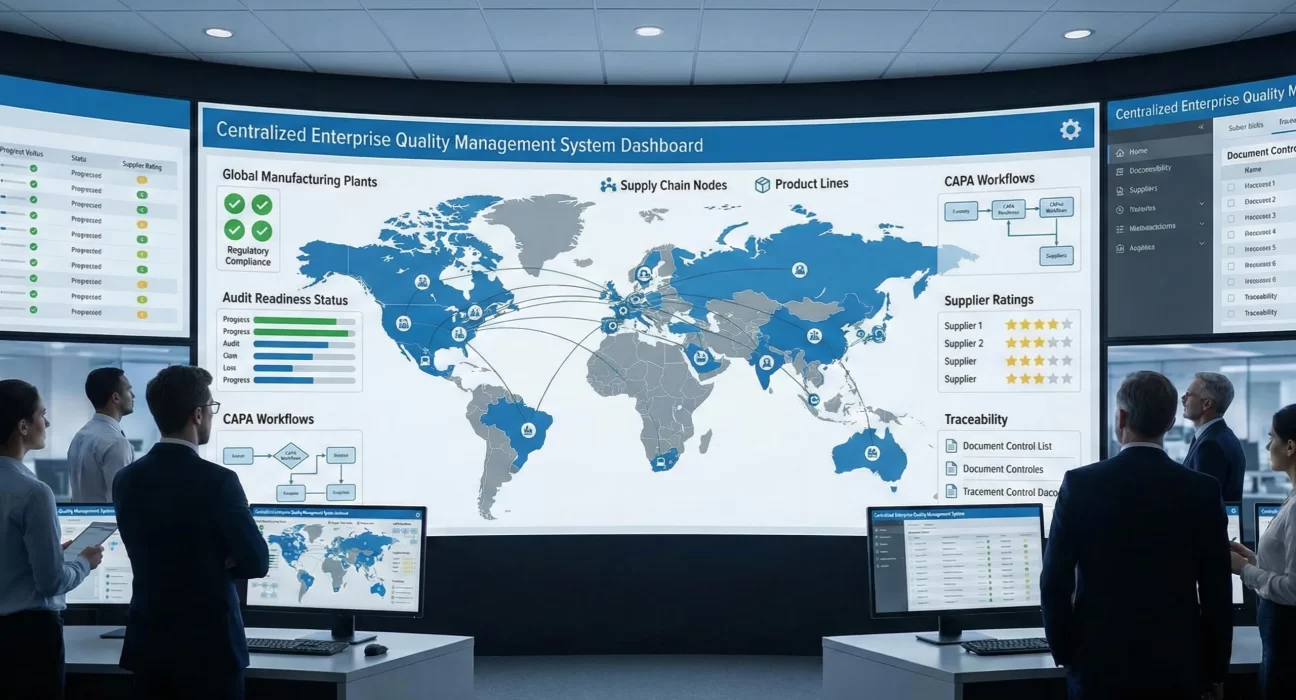
Regulatory requirements are applied at the product and site level, but compliance oversight needs to happen at the enterprise level. Manufacturing leadership needs visibility into compliance status across all facilities, all product lines, and all regulatory domains. This enterprise-wide visibility is nearly impossible when each site manages compliance independently with local systems and processes.
The typical scenario in large manufacturers is that each facility has its own approach to quality management. They might use the same QMS software, but they have configured it differently, defined processes differently, and structured data differently. Site A tracks CAPAs one way. Site B tracks them another way. Site C is still using spreadsheets. When corporate quality leadership tries to generate an enterprise compliance report, they discover that data cannot be aggregated because it is not comparable across sites.
This fragmentation creates multiple problems. First, it makes enterprise risk assessment difficult. You cannot identify systemic issues or emerging trends when data is inconsistent and incomparable. Second, it makes resource allocation inefficient. Sites might be solving the same problems independently instead of sharing solutions. Third, it creates audit risk. When regulators inspect multiple sites and find different processes and documentation standards, it suggests a lack of centralized quality oversight, which undermines confidence in your compliance program.
Supplier quality management adds another layer of complexity. Regulated manufacturers are responsible not just for their own processes, but for ensuring their suppliers meet quality standards. This requires managing supplier audits, monitoring supplier performance, handling supplier-related non-conformances, and maintaining complete traceability from materials through finished products. At enterprise scale with hundreds or thousands of suppliers across global supply chains, this oversight cannot be managed effectively without systematic QMS infrastructure.
Product changes and process changes also require regulatory notification or approval in many industries. Managing these changes across multiple sites and products requires change control systems that ensure all affected parties are notified, all necessary approvals are obtained, and all documentation is updated. When change control is managed manually or through disconnected systems, changes get missed, notifications are delayed, and compliance gaps emerge.
What Regulators Actually Look For During Inspections
Understanding what regulators prioritize during inspections helps clarify what QMS capabilities actually matter for compliance. Regulators are not just checking boxes against requirements. They are assessing whether your quality system is actually functioning and whether it will reliably prevent quality issues.
Regulators start by examining your procedures. Are they current? Are they followed? Can employees access them easily? Do they reflect actual practice? Gaps between documented procedures and actual practice are one of the most common inspection findings. This happens when document control is poor, when procedures are not updated as processes change, or when sites are working around official procedures because they are impractical.
Next, regulators look at training records. Can you demonstrate that employees are qualified for their roles? Is training documented? Are competency assessments performed? Are retraining requirements being met? In manual systems, training records are often incomplete or outdated because maintaining them is administratively burdensome. This creates immediate compliance exposure.
CAPA systems are heavily scrutinized. Regulators want to see that you are identifying quality issues, investigating root causes, implementing effective corrections, and verifying that corrections worked. They trace CAPAs from identification through closure to assess whether your quality system is actually preventing recurrence of problems. Weak CAPA processes or inadequate documentation are serious findings that suggest systemic quality problems.
Traceability is critical in many regulated industries. Regulators will select specific products or materials and trace them backward through production to raw materials and forward through distribution. They want to verify that you can identify what went into products, where products went, and who was involved at each step. Without systematic QMS infrastructure that links production records, material records, and quality records, this traceability is difficult to demonstrate.
Document control is examined carefully. Regulators check whether controlled documents are actually controlled. They look for obsolete documents still in use, missing approval signatures, inadequate version control, and unclear document hierarchies. Document control failures suggest lack of management oversight and control over critical processes.
Finally, regulators assess management review and continual improvement. They want evidence that leadership is actively engaged in quality oversight, that quality data is being analyzed, that trends are being identified, and that the organization is taking action to improve. This requires reporting and analysis capabilities that many manual or legacy systems simply do not provide.
Building Compliance Infrastructure That Scales
For manufacturing leaders, the question is not whether to invest in QMS infrastructure for compliance. It is how to build that infrastructure in a way that delivers reliable compliance evidence without disrupting operations or consuming excessive resources.
Start by recognizing that this is an enterprise program, not a site-level IT project. Effective compliance infrastructure requires standardized processes, integrated systems, centralized governance, and consistent data structures across your manufacturing operations. This level of standardization and integration requires executive sponsorship, cross-functional coordination, and significant organizational change management.
Process standardization is the foundation. Before implementing or upgrading QMS technology, you need agreement on how core quality processes will work across your organization. What will be standardized globally? What will be managed regionally? What remains locally flexible? These are not technical decisions. They are business and compliance decisions that require input from site quality leaders, regulatory affairs, and corporate quality management.
System integration is equally important. Your QMS needs to connect with ERP systems for material traceability, with manufacturing execution systems for production data, with laboratory systems for test results, and with supplier management systems for vendor quality. These integrations need to be designed for reliability and auditability because regulators will examine the data flows between systems.
Data quality and governance must be addressed explicitly. Compliance evidence is only credible if the underlying data is accurate and complete. This requires master data management, data validation rules, and clear ownership of data quality across systems and sites. Organizations that implement QMS platforms without addressing data quality end up with systems that generate unreliable compliance reports.
Validation requirements for regulated industries add significant time and complexity. Computer system validation is not optional for QMS platforms in industries like pharmaceuticals, medical devices, and aerospace. This means documenting requirements, testing thoroughly, establishing controls to prevent unauthorized changes, and maintaining audit trails. CSV work should be planned as an integrated workstream, not an afterthought after technical implementation is complete.
Change management across manufacturing sites determines whether your new compliance infrastructure actually gets adopted. Quality personnel need to understand how the new system supports their work and supports regulatory compliance. They need training, documentation, and support during the transition. Site leadership needs to be engaged and committed to the change. Without this organizational alignment, even technically sound QMS implementations fail to deliver compliance value.
Realistic timelines for enterprise QMS implementations in regulated manufacturing typically range from twelve to twenty-four months depending on the number of sites, the complexity of regulatory requirements, and the extent of integration needed. Organizations that try to compress these timelines create implementation risk that often results in compliance gaps or operational disruption.
How Ozrit Delivers Compliance Focused QMS for Manufacturers
Ozrit is a global technology services company that implements quality management systems for manufacturers in regulated industries. We have delivered QMS platforms that have successfully supported FDA inspections, EU regulatory audits, and customer quality audits for multinational manufacturers.
Our approach starts with understanding your regulatory obligations and current compliance challenges before designing solutions. We review your regulatory requirements across different jurisdictions, assess your current QMS capabilities, identify compliance gaps, and work with your regulatory affairs and quality leadership to define what success looks like. This discovery work is led by senior consultants who have supported regulatory inspections and understand what regulators actually look for.
We treat compliance as the primary design constraint for QMS implementations in regulated environments. This means configuring systems to generate the audit trails, traceability, and documentation that regulators expect. It means building reporting that answers the questions regulators ask. And it means validating that the system will actually support your compliance obligations before go-live.
Process standardization work happens before technical implementation begins. We facilitate the organizational discussions about what needs to be consistent across your manufacturing operations and what can remain flexible. We document processes in sufficient detail that they can be configured into the QMS correctly and that they will satisfy regulatory expectations.
Integration work is planned and executed as a core workstream. We have connected QMS platforms with ERP, MES, LIMS, and supplier management systems for large manufacturers with complex technology environments. We understand the data flows and traceability requirements that regulatory compliance demands and build integration architecture accordingly.
For regulated manufacturers, we manage computer system validation as an integrated workstream throughout implementation. Our teams include validation specialists who understand FDA, EU, and other regulatory requirements for electronic systems. This integrated approach ensures validation does not become a blocking issue after technical work is complete.
Our directors and principal consultants stay involved throughout these programs because regulatory compliance is too critical to delegate entirely to junior resources. They provide the judgment needed to navigate complex compliance requirements, resolve conflicts between standardization and local needs, and ensure the system will actually support regulatory inspections.
After go-live, we provide 24/7 support to ensure your compliance infrastructure operates reliably. Our support teams understand regulatory requirements and respond immediately to issues that could affect compliance or audit readiness. For manufacturers with upcoming regulatory inspections, this responsive support provides critical assurance.
We have delivered these implementations for manufacturers with dozens of facilities across North America, Europe, and Asia, supporting FDA 21 CFR Part 11, EU GMP, ISO 13485, and other regulatory frameworks.
Final Perspective
For manufacturing leaders, regulatory compliance is not just a quality department responsibility. It is an enterprise risk that requires systematic infrastructure to manage at scale. Modern QMS platforms provide that infrastructure, but only when implemented with proper attention to process standardization, system integration, data quality, and organizational change management. The manufacturers that get this right are the ones that treat QMS implementation as a business program with executive sponsorship, realistic timelines, and partners who understand both regulatory requirements and enterprise delivery.