
Every CFO has sat through that moment. The vendor presents a sleek proposal. The numbers look manageable. The timeline seems reasonable. The technology stack sounds modern. Six months later, the budget has doubled, the delivery date has slipped twice, and nobody can quite explain why the original scope keeps changing.
This is not a failure of technology. It’s a failure of execution.
Enterprise software development in India and globally operates in a paradox. Companies want world-class digital transformation, but they also want it delivered on budget, on time, and without the usual chaos that comes with large-scale IT programs. The problem is not lack of talent or tools. The problem is that most software development partnerships are structured to build features, not to deliver outcomes.
If you’re a CIO, CTO, or CEO reading this, you’ve likely experienced the disconnect. Your organisation approved a major initiative. The vendor was selected carefully. But somewhere between the kickoff and go-live, things started to drift. Stakeholders multiplied. Requirements shifted. Governance became a formality instead of a mechanism. What was supposed to be a strategic advantage turned into a project everyone just wants to finish.
This article is about why that happens, and what actually works when you’re trying to execute enterprise-scale programs without cutting corners or burning budgets.
Why Enterprise Software Programs Go Off Track
Large enterprises don’t fail because of bad ideas. They fail because execution is harder than anyone admits upfront.
When you’re running a mid-to-large organisation, especially one operating across India or globally, you’re not building a single product. You’re managing a live, complex ecosystem. Legacy systems that can’t simply be switched off. Compliance requirements that vary by geography. Internal teams with competing priorities. External vendors with different incentives. And a board that wants measurable ROI, not just progress updates.
Most software vendors approach this reality with a standard playbook: agile sprints, cloud-first architecture, API integrations, DevOps pipelines. All good things. But none of that addresses the actual challenges that derail programs.
The real issues are structural:
Scope is poorly defined upfront, not because people are careless, but because enterprises themselves don’t know exactly what they need until they start building. Requirements gathering becomes a negotiation, and every negotiation introduces delay.
Stakeholder alignment is assumed, not engineered. A digital transformation program touches multiple departments. Each one has a different definition of success. Without a forcing function, consensus never happens.
Governance is treated as overhead. Monthly steering committee meetings where nothing gets decided. Status reports that highlight green when everything is actually amber. Escalation paths that exist on paper but never get used.
Vendor accountability is hard to enforce. Most contracts are structured around effort, not outcomes. If the program runs over budget or timeline, everyone shares the blame, which means nobody really owns it.
Technical debt is invisible until it isn’t. Enterprises have years of accumulated systems, customisations, and workarounds. New software has to integrate with that reality, but most vendors price and plan as if they’re building on a clean slate.
Change management is an afterthought. You can build the most elegant platform in the world, but if your people don’t adopt it, you’ve just created an expensive shelf-ware problem.
This is why enterprises end up in a cycle. They start a program with optimism. Midway through, reality sets in. By the end, they’re just trying to get to go-live without further damage. Then, a year later, they start the next transformation program, hoping it will be different.
What Separates Programs That Succeed from Those That Don’t
The difference is not technology. It’s not even budget.
The programs that succeed the ones that actually deliver value, stay within reasonable cost boundaries, and create long-term capability share a few characteristics that have nothing to do with the frameworks or tools being used.
They start with brutal honesty about scope and constraints. Successful programs don’t pretend the requirements are fully known. They build in structured discovery phases, treat ambiguity as a given, and create decision-making frameworks that allow the program to adapt without becoming chaotic. The goal is not to avoid changes. The goal is to manage changes without derailing timelines or budgets.
They treat governance as a competitive advantage, not a formality. In well-run programs, governance is the mechanism that prevents drift. It’s where trade-offs get made, where priorities get clarified, and where accountability gets enforced. Steering committees actually steer. Program boards make decisions, not just receive updates. Escalations happen early, not when it’s too late to course-correct.
They choose partners based on execution maturity, not just technical capability. Every vendor can code. Not every vendor can manage a program with 15 stakeholders, three legacy systems, and a regulatory deadline. The question is not whether a partner knows React or Kubernetes. The question is whether they’ve successfully delivered programs of similar scale and complexity before, and whether they have the internal discipline to manage dependencies, risks, and timelines without constant hand-holding.
They design for long-term ownership, not just delivery. Most vendors are optimised to build and hand over. But enterprise systems need to evolve. Business requirements change. Regulations shift. Technology stacks need updates. If the partnership ends the moment the system goes live, you’re left managing something you don’t fully understand, with a team that wasn’t part of the original build. Programs that succeed think about sustainability from day one—documentation, knowledge transfer, support models, and evolution roadmaps.
They manage cost as an outcome, not just an input. Cost overruns happen because programs treat budget as a constraint to be managed, rather than an outcome to be engineered. Successful programs build cost discipline into every phase. They track burn rates. They tie spending to milestones. They have mechanisms to detect scope creep early, and decision rights to address it before it compounds. They don’t just ask “are we on budget?” They ask “are we getting the value we expected for what we’re spending?”
None of this is revolutionary. But it’s rare.
The Role of Leadership in Enterprise Execution
Technology programs are not won or lost in sprint planning meetings. They’re won or lost in the decisions executives make about governance, accountability, and trade-offs.
If you’re a CIO or CTO, your job is not to manage the vendor’s backlog. Your job is to create the conditions where the program can succeed. That means setting clear priorities, protecting the program from organisational churn, and making sure governance is a decision-making forum, not a reporting exercise.
If you’re a CEO or CFO, your role is even more critical. Large-scale digital transformation is not just an IT initiative. It’s a business initiative. The board approved the budget because they expect a return. That return doesn’t come from technology. It comes from the business changes the technology enables. If the program is running into trouble, waiting for the next quarterly review to address it is too late. Executive sponsorship means active engagement, not passive oversight.
If you’re a COO or CDO, you’re the bridge between the business and the technology. You understand what the operations teams need, what the customers expect, and what’s realistic given the constraints. Your involvement in governance is what keeps the program grounded in real-world outcomes, not theoretical architectures.
This is not about micromanagement. It’s about accountability. Programs drift when there’s no clear owner. They succeed when someone senior has the authority, the incentive, and the visibility to make sure execution stays on track.
Choosing the Right Partner: What Actually Matters
Vendor selection is where most enterprises make their first mistake. They optimize for cost or brand, and underweight execution capability.
Here’s what matters more than hourly rates or case studies:
Do they understand your operating reality? Some vendors are excellent at building software. Fewer are excellent at building software inside a live, complex enterprise. Can they navigate your internal approvals? Do they know how to work with legacy systems that can’t be replaced yet? Have they managed programs where the requirements evolved mid-flight, and still delivered on time?
Do they have a governance model that works? Ask them how they handle scope changes. Ask them how they escalate risks. Ask them what their steering committee meetings actually achieve. If the answers are vague or theoretical, that’s a signal.
Do they think about the long term? Some vendors are optimised to build and exit. Others are optimised to build, support, and evolve. If you’re investing in a multi-year platform, you need a partner who’s thinking about sustainability, not just delivery.
Do they have skin in the game? Contracts matter. If the commercial model is purely time-and-materials, the vendor has no incentive to be efficient. If there are outcome-based components, or at least risk-sharing mechanisms, the incentives are better aligned.
At Ozrit, we’ve spent years working with enterprises across India and globally, and the pattern is clear. The programs that succeed are the ones where the partnership is structured around shared accountability, not just task execution. Our role is not to take requirements and write code. Our role is to take business problems and deliver working, sustainable solutions—on time, on budget, and with the internal capability to keep them running long after we’ve handed them over.
That’s not a sales pitch. It’s a description of what enterprise execution actually requires.
Managing Cost Without Cutting Corners
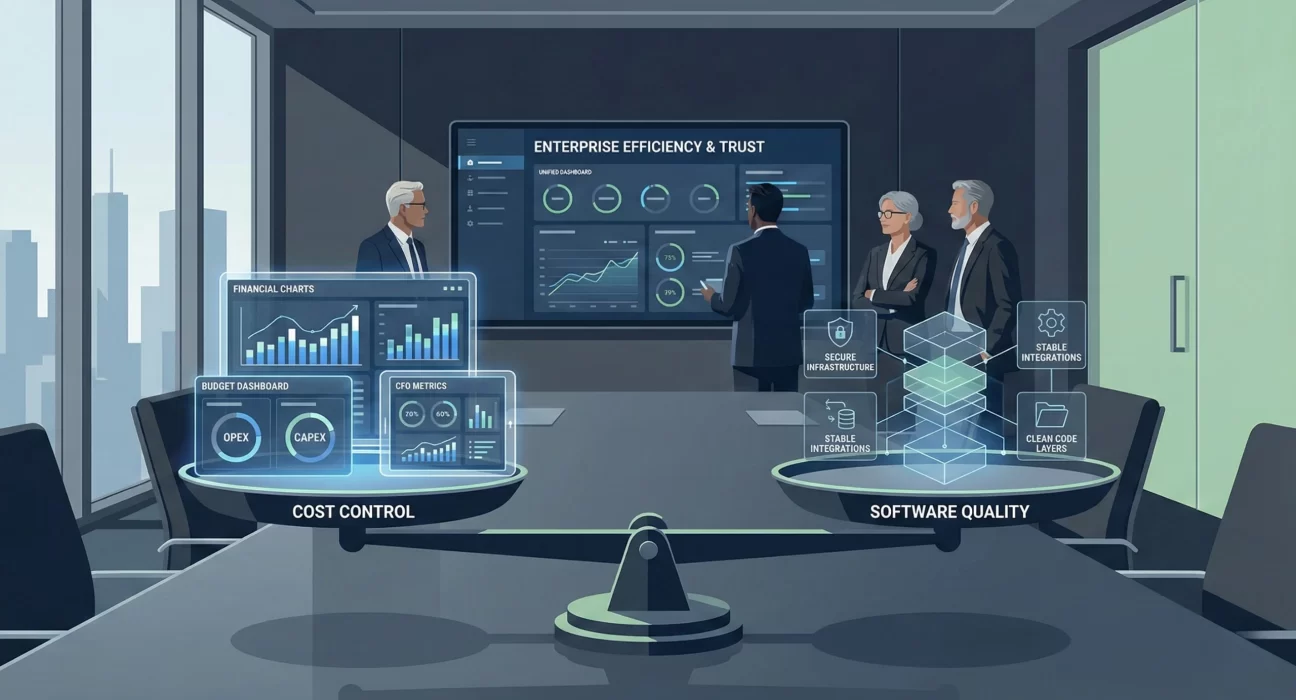
Every CFO wants to know: can we do this without blowing the budget?
The answer is yes, but not by choosing the cheapest vendor or cutting scope arbitrarily.
Cost-effective enterprise software development is about efficiency, not just price. It’s about making sure every rupee spent creates value, and that value compounds over time.
Start with clarity. The biggest cost driver in enterprise programs is rework. Rework happens when requirements are unclear, when stakeholders aren’t aligned, or when technical decisions get made without understanding the business context. Investing time upfront in discovery, in stakeholder workshops, and in architecture planning feels expensive. But it’s far cheaper than rebuilding six months in.
Build incrementally, but with a plan. Agile methodologies are useful, but only if there’s a coherent product vision. Incremental delivery should not mean random feature additions. It should mean progressively building toward a well-defined outcome, with regular checkpoints to validate that you’re on track.
Manage technical debt actively. Enterprises accumulate technical debt over years. New programs often inherit that debt, but rarely budget for it. If you’re integrating with a legacy system, or if you’re building on top of an old codebase, treat that as a known constraint. Budget for it. Plan for it. Don’t pretend it doesn’t exist and then act surprised when it slows you down.
Think about total cost of ownership, not just build cost. The software you deliver today will need to be maintained, updated, and evolved for years. If the architecture is fragile, or if the documentation is poor, or if only the vendor understands how it works, your long-term costs will be much higher than your build costs. Design for sustainability. It’s cheaper in the long run.
Track value, not just spend. Cost discipline is not about minimising expenditure. It’s about maximising return. Some features are worth more than others. Some technical investments unlock future value. Some stakeholder requests are critical, others are nice-to-have. A mature program has the governance and the data to make those distinctions, and to allocate budget accordingly.
None of this is about cutting corners. It’s about making smart trade-offs, based on real information, with clear accountability.
What Long-Term Partnerships Actually Look Like
Most vendor relationships are transactional. You need something built, you hire a team, they build it, they leave. A few months later, you need something else, and the cycle repeats.
Long-term partnerships are different. They’re built on trust, shared context, and mutual accountability.
When you work with the same partner over multiple programs, they start to understand your business, not just your requirements. They know your stakeholders. They know your legacy systems. They know which battles are worth fighting and which ones aren’t. That institutional knowledge is valuable. It makes every subsequent engagement faster, smoother, and more likely to succeed.
Long-term partners also have a different incentive structure. If they know they’ll be working with you for years, they’re more likely to make decisions that prioritise sustainability over speed. They’re more likely to invest in knowledge transfer, in documentation, in training your internal teams. They’re more likely to flag risks early, because they know the relationship doesn’t end at go-live.
At Ozrit, we’ve seen this play out repeatedly. The enterprises we’ve worked with longest are the ones where we’ve become embedded in their execution model. We’re not just a vendor they call when they need something built. We’re a partner they involve in planning, in governance, in capability building. That’s not because we’re particularly special. It’s because we’ve earned trust through consistent delivery, and because we’ve designed our engagement model to support long-term outcomes, not just short-term projects.
If you’re evaluating a technology partner, ask yourself: do I want a contractor, or do I want a partner? There’s a place for both. But for large-scale, multi-year programs, the latter is almost always better.
Final Thoughts: Execution Beats Strategy
There’s no shortage of good ideas in enterprise technology. Digital transformation strategies are everywhere. Roadmaps are well-intentioned. Budgets get approved.
What’s scarce is execution.
Execution is the ability to take a complex, multi-stakeholder, multi-system, multi-year program and deliver it on time, on budget, and with the outcomes you promised. It’s the ability to manage scope creep without killing momentum. It’s the ability to navigate governance without getting stuck in bureaucracy. It’s the ability to make hard trade-offs without losing sight of the goal.
If you’re a C-level executive responsible for technology, your job is not to pick the best architecture or the most fashionable framework. Your job is to create the conditions where execution can happen. That means choosing the right partners, structuring the right governance, and maintaining the right level of engagement throughout.
It also means being honest about what works and what doesn’t. If a program is struggling, pretending it’s fine doesn’t help. If a vendor isn’t delivering, hoping they’ll improve on their own doesn’t work. If your internal teams aren’t aligned, launching the program anyway just delays the problem.
Enterprise software development doesn’t have to be a nightmare of overruns, delays, and finger-pointing. It can be predictable, cost-effective, and value-driven. But only if the people leading it and the partners supporting it approach it with the right level of maturity, discipline, and accountability.
That’s the difference between programs that succeed and programs that don’t.