

Introduction
For decades, PG and hostel management in India ran on notebooks, paper registers, and memory. Rent was tracked by hand, tenant details lived in a diary, and occupancy was whatever the owner remembered that week. That approach worked when a PG had a handful of tenants, but it breaks down quickly as properties grow and tenant expectations change. The future of PG management is moving away from this manual approach toward centralised, software-driven systems that handle rent, occupancy, and tenant records automatically.
This article looks at what’s driving that shift, the trends shaping it, and what it means for PG owners deciding how to run their business going forward. Much of this shift is already visible in PG and hostel management software built specifically for how PGs actually operate.
Where PG Management Stands Today
Despite rapid growth in India’s PG and co-living sector, a large share of PG owners still manage their properties the traditional way – registering for rent, using WhatsApp for tenant communication, and using spreadsheets, if anything at all, for reporting.
This mix of manual methods creates a few recurring problems:
- Rent records that don’t match actual payments received
- No easy way to see occupancy across multiple properties
- Tenant KYC and agreement documents stored inconsistently
- Delayed rent reminders because they depend on someone remembering to send them
- Difficulty generating reports for taxes or expansion planning
None of these problems is new. What’s changing is that owners increasingly have a practical alternative, which is pushing the future of PG management toward digital-first operations.
Why the Future of PG Management Is Shifting Toward Software
A few converging factors explain why PG management is moving away from notebooks faster than in previous years.
Growing Number of PGs and Co-Living Operators
As demand for rental accommodation grows in Indian cities, more owners are managing multiple properties rather than a single PG. Multi-property management is nearly impossible to do accurately with paper records alone, since there’s no single view of rent, occupancy, or tenant status across locations.
Rising Tenant Expectations
Today’s PG tenants, especially students and young professionals, expect digital payment options, quick responses to complaints, and clear rent records. A PG that still relies entirely on cash and handwritten receipts can feel outdated compared to competitors offering UPI payments and instant confirmations.
Regulatory and Compliance Pressure
Many states have increased scrutiny on PG accommodations, including tenant verification and safety compliance. Keeping accurate, retrievable KYC and tenant records has moved from a “nice to have” to something owners need for smooth compliance during inspections or audits.
The Cost of Manual Errors
Manual tracking inevitably leads to mistakes — missed rent, double-booked beds, disputed deposits. As competition in the PG market increases, these errors cost owners both money and reputation, making the case for software-based management stronger each year.
Key Trends Shaping the Future of PG Management
Several specific trends are defining how PG management is evolving in India.
1. Digitisation of Rent Collection
Cash-only rent collection is steadily giving way to UPI and digital payments, which are easier to track and reconcile. Digital rent collection also reduces disputes, since payments are automatically logged rather than relying on handwritten receipts.
2. Centralised Tenant and KYC Records
Instead of storing tenant ID proofs and agreements in separate folders or physical files, more PGs are centralising this information digitally. This makes it faster to retrieve records during disputes, audits, or when a tenant vacates and needs final settlement.
3. Real-Time Occupancy Tracking
Owners running multiple properties increasingly need to see occupancy across all locations at once, not property by property. Real-time occupancy tracking helps identify vacant beds quickly and avoid the lost revenue that comes from beds sitting empty longer than necessary.
4. Data-Driven Decision Making
Reports on rent collection trends, occupancy rates, and expense patterns are becoming standard tools for PG owners, not just larger co-living chains. This data helps owners decide when to raise rent, where to cut costs, or which properties are underperforming.
5. Rise of Organised PG and Co-Living Chains
Branded co-living operators are expanding across major Indian cities, often managing hundreds of beds through centralised systems. Independent PG owners are increasingly adopting similar tools on a smaller scale to stay competitive with these larger, more organised players.
Notebooks vs. Smart Software: A Practical Comparison
| Aspect | Notebook / Manual Tracking | Software-Based Management |
|---|---|---|
| Rent tracking | Manual entries, error-prone | Automated, linked to payments |
| Tenant records | Scattered across files or diaries | Centralised and searchable |
| Occupancy visibility | Property-by-property, delayed | Real-time, across properties |
| Rent reminders | Manual calls or messages | Automated reminders |
| Reporting | Manual calculation | Generated automatically |
| Scalability | Difficult beyond one property | Manageable across multiple PGs |
This comparison isn’t about manual methods being incapable — many owners have run successful PGs this way for years. It’s about how much harder that approach becomes to sustain as properties, tenants, and compliance requirements grow.
Challenges PG Owners Face During the Transition
Moving from notebooks to software isn’t automatic, and owners often face a few practical hurdles.
- Resistance to change – long-time owners are comfortable with familiar manual routines
- Initial data entry effort – migrating existing tenant and rent records takes time upfront
- Staff training – wardens or managers need to learn new digital workflows
- Choosing the right tool – not every PG management platform fits every property’s needs
These challenges are real, but they’re typically one-time costs. Once records are digitised and staff are comfortable with the system, day-to-day management usually becomes noticeably easier than the manual process it replaced.
What This Means for PG Owners Today
The future of PG management doesn’t require every owner to overhaul their operations overnight. For a single small PG, a simple digital record might be enough for now. But as occupancy grows, or as an owner takes on a second or third property, the gap between manual and software-based management widens quickly.
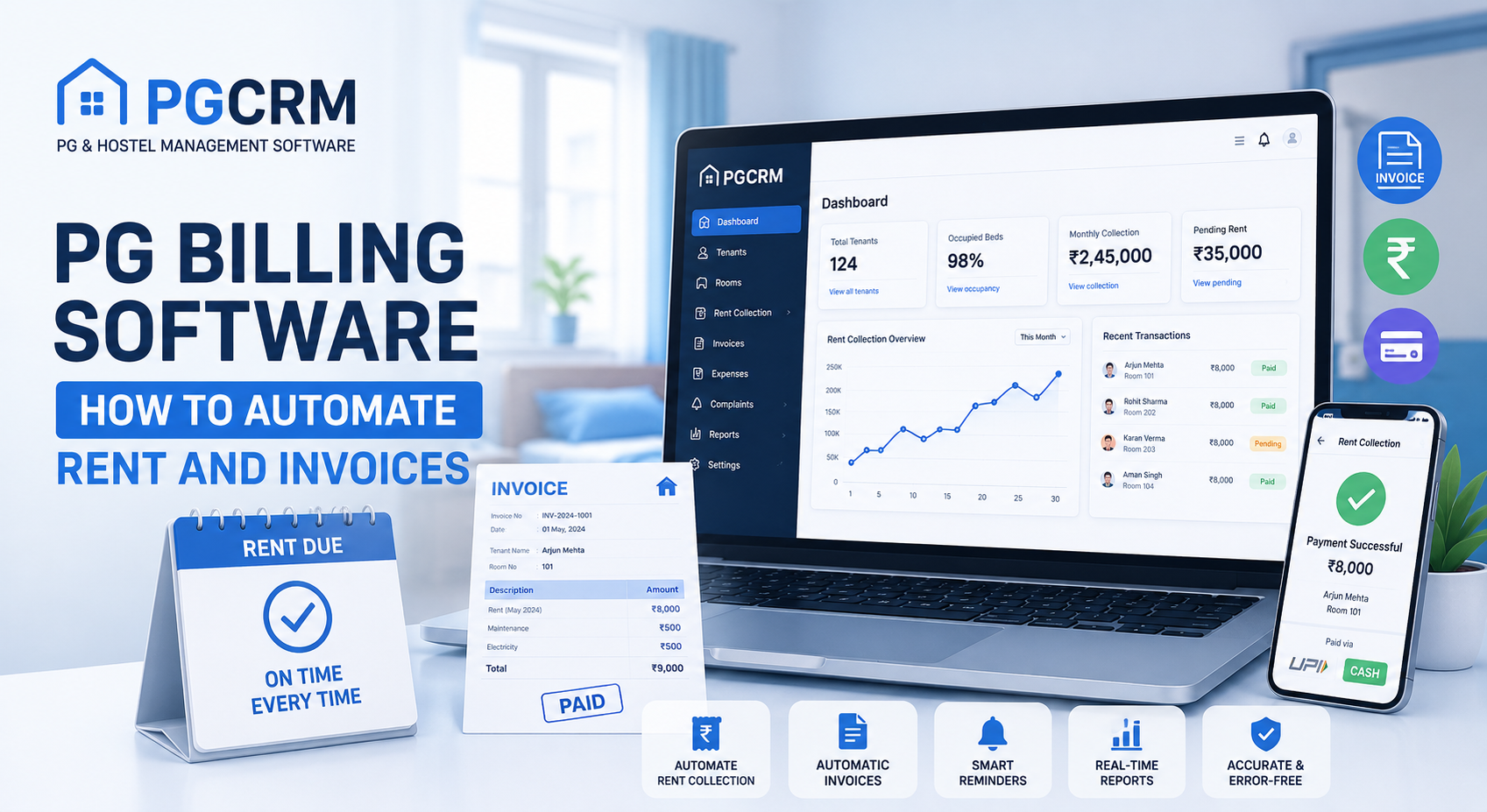
Owners planning to grow, formalise compliance, or compete with organised co-living chains benefit most from moving early. Using PG management software such as PGCRM, owners can centralise rent tracking, tenant KYC, occupancy data, and complaint management without needing separate tools for each function.
How PGCRM Fits into the Future of PG Management
PGCRM is built around the specific, everyday tasks PG and hostel owners deal with — not generic property management features borrowed from commercial real estate software.
Relevant capabilities include:
- Centralised building, room, and bed management
- Rent tracking with cash and UPI payment support
- Automated rent reminders
- Tenant KYC management
- Complaint tracking
- Expense tracking and reports
Rather than replacing an owner’s judgement, this kind of system removes the manual effort behind tracking rent, occupancy, and tenant records – the exact areas where notebooks and spreadsheets tend to fall behind.
Frequently Asked Questions
What does the future of PG management look like in India?
The future of PG management is shifting from manual, paper-based tracking toward centralised software that handles rent, occupancy, and tenant records digitally. This shift is being driven by growing tenant expectations, multi-property management needs, and increased compliance requirements around tenant verification.
Why are PG owners moving away from notebooks and registers?
Manual tracking becomes harder to manage accurately as the number of tenants and properties grows. Notebooks and registers are prone to errors, don’t offer real-time visibility, and make it difficult to generate reports, which pushes owners toward digital alternatives as their business scales.
Is PG management software only useful for large co-living chains?
No. While large co-living operators were early adopters, PG management software is increasingly practical for owners with even a single property, especially once tenant turnover, rent tracking, and compliance needs start to feel harder to manage manually.
What are the biggest trends in PG management right now?
Key trends include digital rent collection through UPI, centralised tenant KYC records, real-time occupancy tracking across properties, and data-driven reporting. Together, these trends reflect a broader move toward treating PG management as a structured business rather than an informal side operation.
How does technology help with PG compliance requirements?
Centralised digital records make it easier to retrieve tenant KYC and agreement documents quickly during inspections or audits. This is increasingly important as several states tighten scrutiny on PG accommodations around tenant verification and safety.
Do small PG owners need management software right now?
Not necessarily right away. A single small PG can often manage well with a simple, consistent manual process. However, as occupancy grows or a second property gets added, software-based management typically becomes far more practical than continuing to scale manual tracking.
Conclusion
The future of PG management in India is moving steadily from notebooks and memory toward centralised, digital systems that handle rent, occupancy, and tenant records automatically. This shift isn’t about abandoning manual methods overnight — it’s about recognising when those methods start holding a growing PG business back. Explore PGCRM to simplify your PG and hostel management, from rent tracking and tenant records to occupancy and reporting, all in one place.