
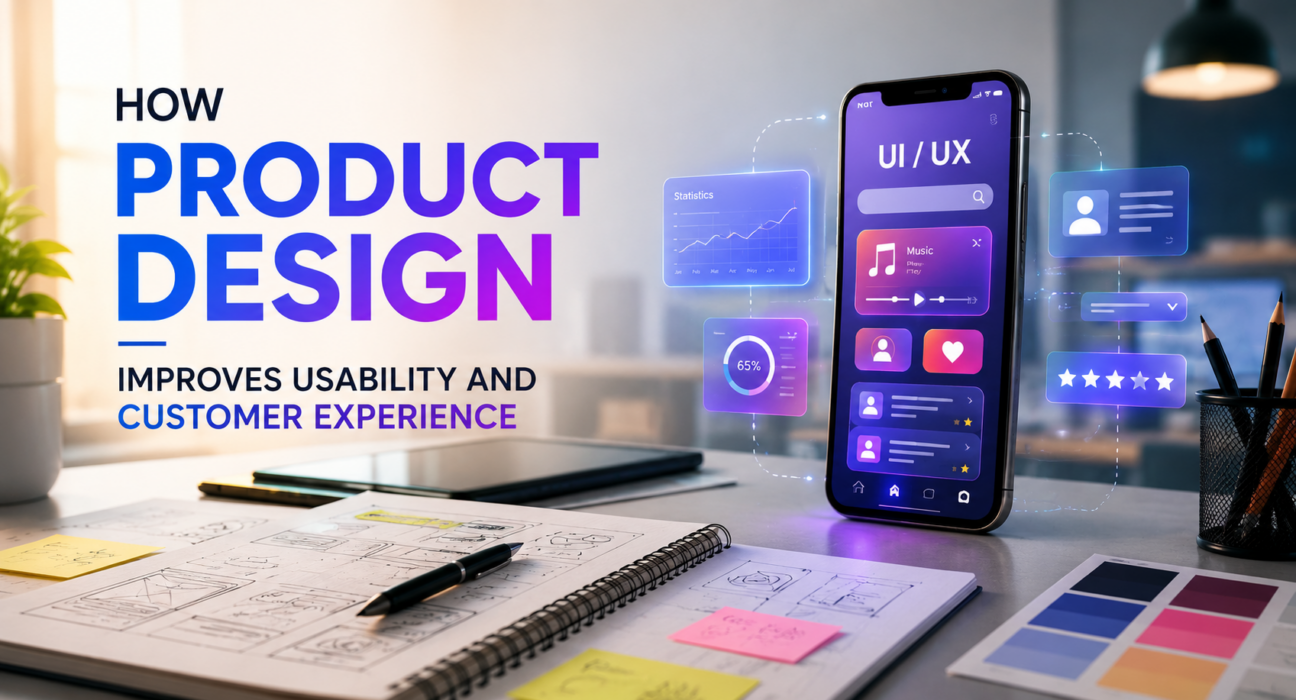
Every product tells users something before they read a single word of copy. The layout, the flow, the way a button responds to a click – all of it shapes whether someone trusts a product enough to keep using it. This is the practical power of product design: it turns a functional tool into an experience people actually want to return to.
For founders, product managers, and business owners, this isn’t an abstract design conversation. A poorly designed product leads to confused users, higher support costs, and lost revenue. A well-designed one does the opposite – it reduces friction, builds trust, and turns first-time users into repeat customers. This article breaks down exactly how product design influences usability and customer experience, and what businesses can do to get it right.
What Is Product Design?
Product design is the process of defining how a product looks, feels, and functions to solve a real user problem. It sits at the intersection of user needs, business goals, and technical feasibility.
The discipline typically includes:
- UX (User Experience) design – how the product behaves and flows
- UI (User Interface) design – how the product looks visually
- Interaction design – how users interact with specific elements
- Information architecture – how content and features are organized
- Usability testing – validating design decisions with real users
This work is not just about aesthetics. It’s about making a product easy to understand, easy to use, and genuinely useful — which is why so many businesses now research software development companies and design specialists together, since the two disciplines are closely linked.
Why Product Design Directly Affects Usability
Usability is the measure of how easily a user can achieve their goal within a product. Thoughtful design directly determines that ease, because it shapes the path a user takes from start to finish.
1. It Reduces Cognitive Load
When an interface is built with clear visual hierarchy, familiar patterns, and logical navigation, users don’t have to think hard about what to do next. Every extra decision point is a chance for someone to hesitate, get confused, or leave.
Good design removes unnecessary choices and guides users naturally toward their goal.
2. It Creates Predictable Interactions
Consistency is one of the core principles of usable interfaces. When buttons, menus, and icons behave the same way throughout a product, users build confidence quickly. Inconsistent layouts force people to relearn the interface on every screen, which increases errors and frustration.
3. It Prevents and Recovers From Errors
Well-built products anticipate mistakes. Clear error messages, confirmation steps for irreversible actions, and undo options are all decisions made early in the design process to protect the experience when something goes wrong.
4. It Supports Accessibility
Usability isn’t just about ease of use for the average user – it includes people with different abilities, devices, and contexts. Interfaces that consider color contrast, text size, keyboard navigation, and screen reader compatibility expand who can successfully use a product.
How Design Choices Shape Customer Experience
Customer experience (CX) is broader than usability. It includes every emotional and practical touchpoint a customer has with a business – and the way a product is designed plays a central role in shaping that experience.
It Builds Trust From the First Interaction
Users form an opinion about a product within seconds. Clean layouts, clear messaging, and intuitive navigation signal professionalism and reliability. A cluttered or confusing interface, on the other hand, can make even a technically strong product feel untrustworthy.
It Reduces Friction Across the Customer Journey
Thoughtful design smooths out the entire journey – from onboarding to daily use to renewal or repurchase. Every unnecessary step, unclear instruction, or confusing screen adds friction that can push customers toward a competitor.
It Encourages Long-Term Engagement
Products that are easy and enjoyable to use naturally encourage repeat usage. This is especially important for SaaS companies and subscription-based businesses, where retention depends heavily on how smooth the day-to-day experience feels.
It Lowers Support and Onboarding Costs
When an interface is intuitive, customers need less help understanding it. This reduces the burden on customer support teams and shortens onboarding time, which has a direct impact on operational costs.
Key Principles of Effective Product Design
Businesses aiming to improve usability and customer experience should focus on these core principles:
- User-Centered Design – Decisions should be based on real user needs and behavior, not assumptions.
- Simplicity – Remove anything that doesn’t serve the user’s goal.
- Consistency – Maintain uniform patterns across the entire product.
- Clear Visual Hierarchy – Guide attention to what matters most on each screen.
- Feedback and Responsiveness – Let users know their actions were received and understood.
- Accessibility – Design for the widest possible range of users and devices.
- Iterative Testing – Validate choices with real users and refine continuously.
Product Design vs. Visual Design: Understanding the Difference
A common misconception is that this work is only about how something looks. In reality:
| Aspect | Product Design | Visual Design |
|---|---|---|
| Primary Focus | How the product works and solves user problems | How the product looks |
| Scope | End-to-end user journey, flows, structure | Color, typography, imagery, style |
| Success Metric | Usability, task completion, retention | Visual appeal, brand consistency |
| Involves | UX research, information architecture, interaction design | UI styling, branding elements |
Both are essential, but usability and customer experience are primarily driven by the broader discipline – not just visual polish. For a deeper look at how the two disciplines differ in practice, see this guide to UI/UX design agencies.
Common Mistakes That Hurt Usability
Businesses often unintentionally damage usability through avoidable mistakes:
- Overloading screens with too many options or too much information
- Inconsistent navigation patterns across different sections
- Ignoring mobile responsiveness
- Skipping usability testing before launch
- Prioritizing visual trends over functional clarity
- Failing to design for error states and edge cases
- Not gathering user feedback after launch
Avoiding these mistakes requires a deliberate, research-backed process rather than guesswork.
How Businesses Can Improve Their Product Design Process
Improving how a product is designed is an ongoing effort, not a one-time project. Businesses can take a structured approach:
- Start with user research. Understand real pain points before designing solutions.
- Map the user journey. Identify every touchpoint where friction could occur.
- Prototype and test early. Validate ideas before investing in full development.
- Use data and feedback. Analytics and user feedback should continuously inform updates.
- Involve cross-functional teams. The best outcomes come from designers, developers, and product managers collaborating closely.
For companies that don’t have in-house design expertise, working with an experienced UI/UX team can help translate business goals into a usable, well-structured product. Businesses evaluating potential partners can use a platform like GoFirms to research and compare design agencies and specialists based on their focus areas and experience. You can also explore GoFirms’ web development companies directory or its mobile app development companies listings if your product spans multiple platforms.
Frequently Asked Questions
What is the difference between product design and UX design? Product design is a broader discipline that includes UX design along with UI design, strategy, and business alignment. UX design specifically focuses on the user’s experience and interaction flow, while the broader discipline also considers how that experience fits business and market goals.
Why does this matter for customer retention? Customers stay with products that are easy to use and consistently meet their needs. A poorly designed product creates friction that drives users toward competitors, while a thoughtfully designed one builds the kind of reliability that encourages long-term use.
How does it affect a company’s revenue? Usable products convert more visitors into customers, reduce churn, and require less customer support. These factors directly affect revenue by improving both acquisition efficiency and customer lifetime value.
Do small businesses need professional design services? Yes, especially if the product is customer-facing. Even simple tools benefit from clear, user-friendly interfaces. Small businesses can start with basic usability testing and gradually invest in more advanced support as the product grows.
How do I know if my product has usability problems? Common signs include high drop-off rates, frequent support tickets about basic tasks, low feature adoption, and negative user feedback about confusion or difficulty. Testing with real users is the most reliable way to identify specific problem areas.
How can I find a reliable design agency? Look for agencies with relevant portfolio experience, a clear process, and strong client feedback. Platforms like GoFirms allow businesses to research and compare UI/UX design agencies based on their expertise, helping narrow down the right fit before reaching out.
Is this a one-time project or an ongoing process? It should be treated as an ongoing process. User needs, market conditions, and technology evolve, so products need regular usability reviews and updates to stay effective and competitive.
Conclusion
Product design is not a finishing touch – it’s a core driver of usability and customer experience. Every decision, from navigation structure to error handling, shapes whether users can accomplish their goals easily and whether they’ll want to come back.
Businesses that invest in user-centered, consistent, and accessible design see the results in higher engagement, stronger retention, and lower support costs. Whether you’re refining an existing product or building something new, prioritizing this work early pays off across the entire customer journey.
If your business needs help identifying the right partner, platforms like GoFirms make it easier to research and compare UI/UX design agencies and specialists suited to your specific goals.