
Every business eventually hits the same wall: growth outpaces the team’s ability to keep up. Manual workflows slow down, small errors multiply, and employees spend more time on repetitive tasks than on the work that actually moves the business forward. This is where AI for business operations has become a practical answer rather than a futuristic idea.
Artificial intelligence is no longer limited to large tech companies with dedicated data science teams. Today, AI tools are embedded in everyday software used by finance teams, marketing departments, HR, customer support, and operations managers. Businesses of all sizes are using AI to automate routine work, reduce errors, make faster decisions, and free up employees for higher-value tasks.
This article breaks down how AI is actually being used across business operations today, where it delivers the most value, and how business leaders can start applying it without overhauling their entire tech stack.
What Does “AI for Business Operations” Actually Mean?
AI for business operations refers to the use of artificial intelligence tools and technologies to automate, optimize, and support the day-to-day processes that keep a business running. This includes areas like:
- Workflow automation
- Data analysis and reporting
- Customer service and support
- Inventory and supply chain management
- Financial operations
- HR and recruitment
- Marketing and sales operations
In practice, this doesn’t necessarily mean building a custom AI system from scratch. Most businesses adopt AI through software they already use, or through targeted tools designed to solve one specific operational problem.
Why Businesses Are Investing in AI Right Now
Business leaders aren’t adopting AI because it’s trendy. They’re adopting it because the pressure to do more with fewer resources keeps increasing. A few common drivers show up again and again:
- Rising operational costs make manual, labor-intensive processes harder to justify.
- Customer expectations for fast responses and personalized service keep climbing.
- Competitive pressure pushes companies to move faster than manual processes allow.
- Remote and distributed teams need centralized systems that don’t depend on someone manually checking every step.
The businesses seeing the biggest impact aren’t necessarily the ones using the most advanced AI. They’re the ones that identified a clear operational bottleneck and applied the right tool to it.
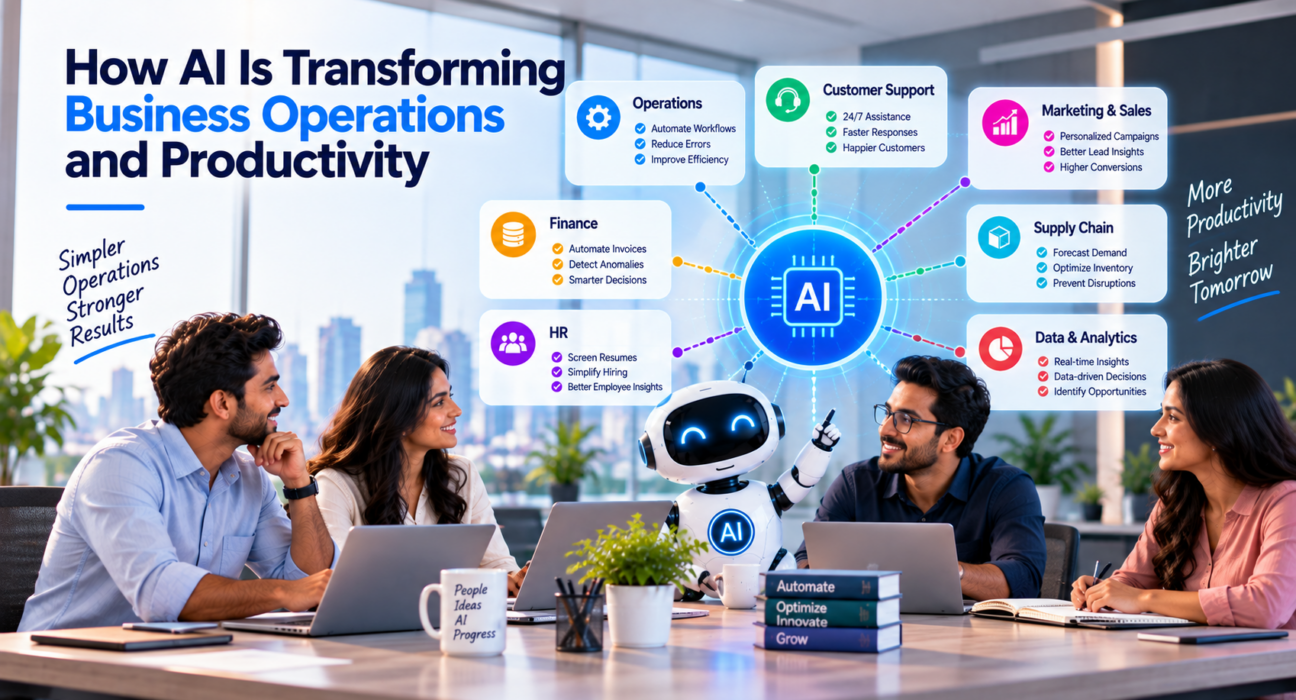
Key Areas Where AI Is Transforming Business Operations
1. Workflow and Process Automation
Repetitive, rules-based tasks are the easiest and most common starting point for AI adoption. This includes things like:
- Automatically routing support tickets to the right team
- Extracting data from invoices or forms
- Triggering approvals based on predefined conditions
- Scheduling and calendar coordination
Automation tools reduce the time employees spend on administrative work and reduce the chance of human error in repetitive steps.
2. Data Analysis and Business Intelligence
AI-powered analytics tools can process large volumes of business data much faster than manual review. Instead of waiting for a weekly or monthly report, decision-makers can access near real-time insights on sales trends, customer behavior, or operational performance.
This matters because faster insight generally means faster decisions. A retail business, for example, can spot a slow-moving product line early instead of discovering it at quarter-end.
3. Customer Support and Service Operations
AI chatbots and virtual assistants now handle a meaningful share of first-line customer interactions. They can:
- Answer common questions instantly, 24/7
- Route complex issues to human agents with relevant context already attached
- Reduce average response times
This doesn’t replace human support teams. It changes their role – agents spend more time on complex, high-value interactions instead of repeating the same answers all day.
4. Supply Chain and Inventory Management
AI models are widely used to forecast demand, optimize stock levels, and flag potential supply chain disruptions before they become costly problems. Businesses that rely on physical inventory – retail, manufacturing, distribution – often see some of the clearest ROI from this category of AI use.
5. HR and Recruitment Operations
AI tools assist with resume screening, interview scheduling, and identifying patterns in employee engagement or turnover. This helps HR teams manage a higher volume of applicants and administrative work without needing to scale headcount proportionally.
6. Marketing and Sales Operations
AI supports tasks such as:
- Personalizing email and content recommendations
- Scoring and prioritizing sales leads
- Analyzing campaign performance
- Generating first drafts of marketing content
These tools don’t replace strategy or creativity, but they significantly reduce the time spent on repetitive execution work.
How to Start Using AI in Business Operations (Step-by-Step)
Businesses that adopt AI successfully tend to follow a similar pattern. Here’s a practical starting point:
- Identify the bottleneck first. Look for a process that’s repetitive, time-consuming, or error-prone – not a technology to adopt for its own sake.
- Start with one use case. Avoid trying to transform every department at once. Pick one workflow and prove value before expanding.
- Evaluate build vs. buy. Many operational problems can be solved with existing AI-powered software. Custom development makes more sense for unique or complex workflows.
- Involve the team that will use it. Tools adopted without input from the people doing the work often go unused.
- Measure results. Track time saved, error reduction, or cost impact so you can justify further investment.
- Scale gradually. Once a use case proves valuable, expand to adjacent processes rather than making sweeping changes at once.
Common Challenges Businesses Face When Adopting AI
AI adoption isn’t automatically smooth. Common obstacles include:
| Challenge | Why It Happens | Practical Response |
|---|---|---|
| Poor data quality | AI tools rely on clean, structured data | Audit and clean data before implementation |
| Employee resistance | Fear of job displacement or unfamiliar tools | Involve teams early and clarify AI’s role as a support tool |
| Unclear ROI | Tools adopted without a defined problem to solve | Start with a specific, measurable use case |
| Integration issues | New AI tools don’t connect well with existing systems | Prioritize tools with strong integration support |
| Choosing the wrong vendor or partner | Mismatched expertise or unclear requirements | Research and compare providers carefully before committing |
That last point is often underestimated. Selecting the right technology partner — whether for a custom AI integration, a workflow automation tool, or a broader software project – has a major impact on how smoothly adoption goes.
Do You Need a Technology Partner to Implement AI?
For simple use cases, off-the-shelf AI software is often enough. But for more complex operational needs – custom integrations, industry-specific workflows, or AI features built into an existing product – many businesses work with a software development company, IT service provider, or SaaS specialist.
If you’re evaluating outside help, it’s worth comparing providers based on relevant experience, past project types, and communication style, rather than choosing based on price alone. This is one of the areas where a discovery platform like GoFirms can help: businesses can research and compare software development companies, IT service providers, and other technology partners in one place before making a hiring decision.
[Internal Link Suggestion: GoFirms Software Development Company Category Page]
The Future of AI in Business Operations
AI’s role in business operations is likely to keep expanding, but the direction is fairly predictable: more automation of repetitive work, better predictive insights, and tighter integration between AI tools and everyday business software. The businesses that benefit most won’t necessarily be the earliest adopters of every new AI tool – they’ll be the ones that apply AI deliberately to real operational problems, measure results, and adjust as they go.
Frequently Asked Questions
What is AI for business operations? AI for business operations refers to using artificial intelligence tools to automate, optimize, or support day-to-day business processes such as workflow automation, data analysis, customer support, inventory management, and HR administration. The goal is to reduce manual work and improve decision-making speed and accuracy.
Is AI only useful for large companies? No. Many AI tools are built for small and mid-sized businesses and are available as affordable software subscriptions rather than custom-built systems. Small businesses often use AI for customer support automation, marketing, and basic data analysis.
What business processes benefit most from AI? Repetitive, rules-based, and data-heavy processes tend to benefit most – including customer support, data entry, reporting, inventory forecasting, and lead scoring. Processes requiring nuanced human judgment usually need a human-AI combination rather than full automation.
Do I need custom software to use AI in my business? Not always. Many operational problems can be solved with existing AI-powered software. Custom development is usually only necessary for unique workflows, deep system integrations, or industry-specific requirements.
How do I choose the right AI or technology partner? Look for relevant industry experience, a clear understanding of your operational challenge, and a track record with similar projects. Comparing multiple providers – using a platform like GoFirms to research software development companies or IT service providers – can help you make a more informed decision.
Will AI replace employees in business operations? In most cases, AI changes roles rather than eliminating them outright. It typically takes over repetitive tasks, allowing employees to focus on judgment-based, strategic, or relationship-driven work.
How long does it take to see results from AI adoption? This varies by use case. Simple automation tools can show measurable time savings within weeks. More complex implementations, such as predictive analytics or custom integrations, may take a few months to show clear ROI.
Conclusion
AI is reshaping business operations by automating repetitive tasks, speeding up decision-making, and giving teams more time to focus on higher-value work. The businesses seeing the strongest results aren’t chasing every new AI trend – they’re identifying specific operational bottlenecks and applying focused solutions, whether that’s existing software or a custom-built system.
If your business is exploring AI adoption and considering outside help, take time to research and compare potential technology partners rather than choosing the first option you find. Platforms like GoFirms can support that process by helping businesses discover and evaluate software development companies, IT service providers, and other technology partners suited to their specific operational needs.