

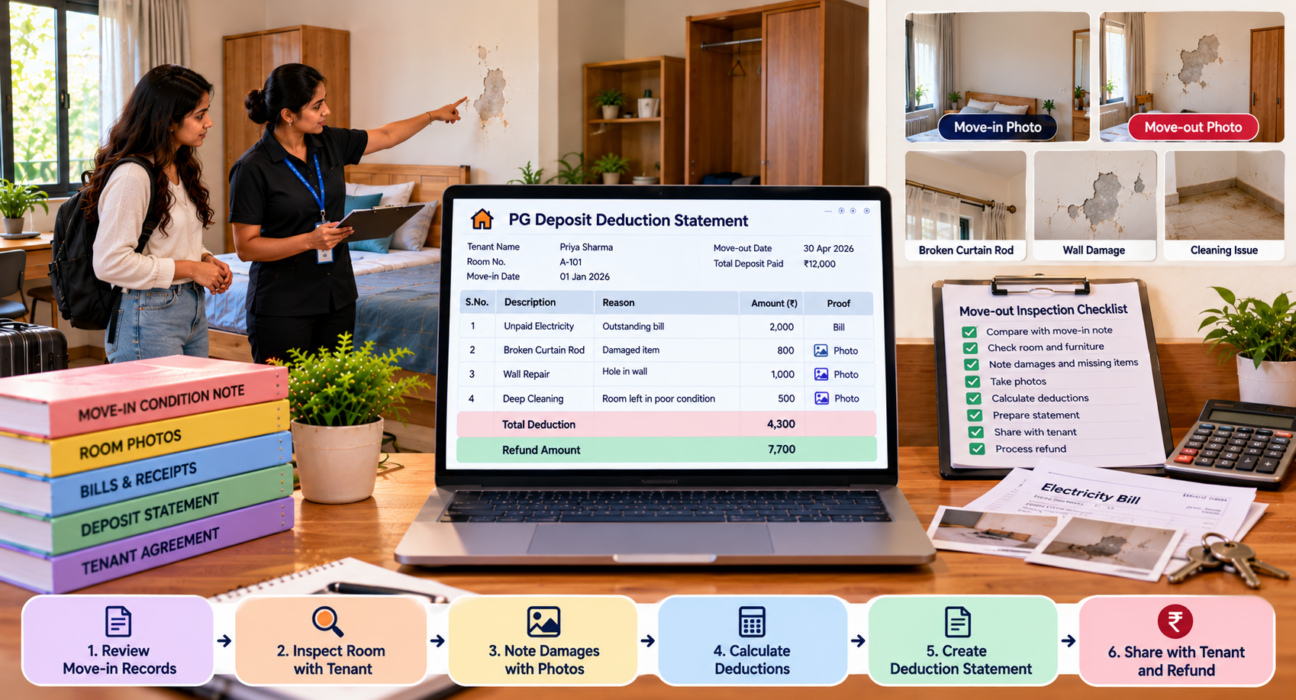
The tenant has packed up, handed over the key and is waiting for the deposit. You’ve found a cracked tile, a missing curtain rod and a pending electricity amount. A week later, the tenant gets a message: “₹4,000 deducted for repairs. Refund ₹8,000.” No breakdown, no bills, no photos. The tenant is angry and says they left the room cleaner than they found it.
Most deposit disputes aren’t about the amount. They’re about not knowing how the amount was reached. A clear PG deposit deduction statement fixes that by showing every figure, its reason and its proof on one page. This guide shows how to build one, with a sample you can adapt and a way to handle disagreements. If you use PG and hostel management software, tenant records, deposits and settlements are easier to keep consistent.
The Short Answer
A transparent PG deposit deduction statement lists the deposit received, each deduction with a reason, amount and supporting proof, the final refund, the date and how it will be paid. It compares the room against the move-in condition note, separates normal wear from damage and is shared in writing with the tenant before or at the time of refund.
Why a Written Statement Matters
A deposit isn’t your money. It’s held against specific things, and the tenant has every right to know what happened to it. A written statement helps both sides.
- Fewer arguments. People accept deductions they understand.
- Faster settlements. Questions get answered on the page, not over days of messages.
- Better reputation. Tenants talk, and “he explained everything” travels as far as “he cut my deposit.”
- A record for you. If a dispute arises later, you can show what you did and why.
- Consistent practice. Every tenant gets the same format, whoever handles it.
Step 1: Start With Records Made at Move-In
You can’t prove what changed if you never recorded what was there. The statement is only as good as the notes behind it.
At move-in, create:
- A condition note listing walls, fittings, furniture, bathroom and any existing marks
- Photos of the room, bed, washroom and cupboards, with dates
- A list of items provided, such as mattress, curtains, cupboard keys and chairs
- The agreed deposit amount and the conditions for deduction, written in the agreement
- A signature or written confirmation from the tenant that the note is correct
If you’ve already accepted tenants without a condition note, start doing it now for new joiners. For existing ones, use whatever photos and records you have.
Step 2: Inspect the Room With the Tenant Present
A joint inspection on move-out day settles most disagreements before they start.
- Walk through the room together, using the move-in note.
- Point out any differences and let the tenant respond on the spot.
- Take dated photos of anything you plan to deduct for.
- Note what’s normal wear and what isn’t. A faded wall after a year is different from a hole in it.
- Agree on what’s been noted, even if you don’t agree on the cost yet.
If the tenant can’t attend, inspect anyway, take photos and share them promptly. Tell them the date you did it.
Step 3: Separate What You Can Deduct From What You Can’t
This is where trust is won or lost. Be honest about the difference between damage and ordinary use.
| Usually reasonable to consider | Usually treated as normal wear |
|---|---|
| Unpaid rent or dues up to the move-out date | Light fading or minor scuffs on walls |
| Unpaid electricity or other agreed charges | Slightly worn paint after a long stay |
| Damage beyond normal use, like broken fittings or holes in walls | Mild wear on mattress or bedsheets |
| Missing items you provided, like keys, curtains or furniture | Loosened screws or hinges from regular use |
| Deep cleaning if the room is left in unusually bad condition and your agreement says so | Normal dust and light marks |
| Fines agreed in writing at move-in | Fines that were never mentioned |
What counts as reasonable depends on your agreement and local practice. Check both before you decide what to deduct, and don’t add charges that were never agreed.
Step 4: Price Each Deduction Fairly
Even when a deduction is justified, the amount has to make sense.
- Use the actual cost where possible. A repair bill or receipt is the strongest proof.
- If you haven’t repaired it yet, use a reasonable estimate or a quote, and say clearly that it’s an estimate.
- Account for age. A five-year-old mattress isn’t worth the price of a new one. Charging full replacement for an old item feels unfair.
- Don’t profit from the deposit. A deduction should cover a real cost, not a penalty you made up.
- Keep it proportionate. A small mark shouldn’t cost the price of repainting the room.
- Treat everyone the same. Similar damage should lead to similar deductions.
When in doubt, explain how you arrived at the number. “Replacement cost ₹3,000, item about three years old, deducting 50%” is more convincing than “₹1,500, fixed.”
Step 5: Build the Statement
A deposit deduction statement is a simple document. It doesn’t need to be fancy, but it needs to be complete.
What to include
- Tenant name, room and bed
- Stay dates: joining date and move-out date
- Deposit received: the amount and the date
- Dues up to move-out: pending rent, electricity or other agreed charges, with dates and amounts
- Each deduction: what it is, why, the amount and the proof (photo, bill, quote)
- Total deductions
- Refund amount
- Refund method and date: UPI, cash or bank transfer, and when
- Contact for questions and the date by which the tenant can raise them
- Date of the statement and who prepared it
A sample statement
Here’s an example with assumed figures. Adapt it to your PG.
| Item | Reason | Proof | Amount |
|---|---|---|---|
| Deposit received | Held at joining on 1 June | Receipt | ₹12,000 |
| Rent for last 6 days of stay | Moved out on 6th, notice period applies | Rent record | −₹1,200 |
| Electricity charge | Agreed charge for last month | Charge note | −₹450 |
| Cupboard door repair | Broken hinge and panel, beyond normal wear | Photo and repair bill | −₹1,800 |
| Cleaning | Room left in unusually dirty condition, as per agreement | Photos | −₹500 |
| Total deductions | ₹3,950 | ||
| Refund | ₹8,050 |
Refund to be paid by UPI on [date]. Questions about any item can be raised by [date] at [contact].
Attach the photos and bills, or tell the tenant where they can see them.
Step 6: Share It Quickly, and in Writing
Timing matters nearly as much as the figures. A delayed refund creates suspicion even when the deductions are fair.
- Prepare the statement soon after inspection, ideally within a few days.
- Share it in writing, by message, email or print, so the tenant has a copy.
- State the refund date clearly and keep to it.
- Pay the undisputed part promptly if one deduction is in question, where your agreement allows.
- Say what happens next if the tenant disagrees.
Your agreement and local practice may set timelines for refunds. Check them before promising any date, and tell tenants about the timeline when they join, not when they leave.
Step 7: Handle Questions and Disputes Calmly
Even a good statement can bring pushback. How you respond often matters more than the deduction itself.
- Listen first. Let the tenant explain what they disagree with.
- Go through the proof, item by item, using the condition note and photos.
- Admit mistakes. If you’ve made an error, correct it quickly.
- Consider a fair compromise on borderline items, such as wear and tear versus damage.
- Keep the tone respectful, even if the tenant doesn’t.
- Put the outcome in writing, including any revised amount.
- Settle and close. Pay the refund and record it.
If you can’t agree, check your agreement and local practice for the next step, and consider seeking proper advice. Don’t hold the entire deposit hostage over a small disagreement, which usually makes things worse.
Step 8: Record the Settlement
After the refund, keep the paperwork where you can find it.
- The signed or confirmed condition notes from move-in and move-out
- Photos and bills
- The final statement
- Proof of refund, such as a UPI reference
- Any messages about disputes
PGCRM handles deposits, fines, refunds, vacates and settlements, and keeps tenant records and stay history, so the money side of each settlement is saved against the tenant. It records payments by cash or UPI, so you can tie the refund to a transaction. It doesn’t list a deduction-statement template or photo storage for room condition, so keep the condition notes and photos together with your own records, and attach them to the statement.
A Quick Checklist for Every Settlement
- Pull the move-in condition note and photos
- Inspect the room with the tenant, if possible
- Note differences and take dated photos
- Separate normal wear from damage
- List dues up to the move-out date
- Price each deduction with proof
- Prepare the statement with all items and the refund amount
- Share it in writing, and confirm the refund date
- Pay the refund and record the transaction
- Store everything together
Common Mistakes in PG Deposit Deduction Statements
- No move-in record. Without it, you can’t show what changed.
- Lump-sum deductions. “Repairs: ₹4,000” with no breakdown invites arguments.
- Charging for normal wear. It feels like a penalty, not a repair.
- Adding charges not in the agreement. Surprise fees destroy trust.
- Using inflated prices. Fair costs hold up better than guesses.
- Delaying the refund. Late payments create suspicion.
- Inspecting without the tenant. You lose the chance to agree on the spot.
- Verbal-only communication. Written statements prevent “I never said that.”
- Treating tenants differently. Consistency protects your reputation.
- Not keeping records. You can’t defend a decision you can’t show.
FAQ
What should a PG deposit deduction statement include?
It should show tenant and room details, stay dates, the deposit received, dues up to move-out, each deduction with a reason, amount and proof, total deductions, the refund amount, the refund method and date and a contact for questions. Attach photos and bills, or say where to see them.
What can a PG deduct from a security deposit?
Commonly, unpaid rent or agreed dues, damage beyond normal wear and tear and missing items you provided. Fines should only apply if agreed in writing. Rules and practices vary, so check your agreement and local requirements before deciding what to deduct.
What is normal wear and tear in a PG room?
It’s the gradual wear that comes from ordinary living, such as light scuffs, faded paint or a slightly worn mattress. Damage is something beyond that, such as holes in walls, broken fittings or stained furniture. Use your move-in note to tell the difference, and be fair.
How soon should a PG refund the security deposit?
Aim to settle as quickly as you reasonably can after the inspection, and keep to the timeline in your agreement. Tell tenants the expected refund period at move-in. Rules and practices can vary, so check your agreement and local requirements.
What proof should I keep for deposit deductions?
Keep the signed or confirmed move-in and move-out condition notes, dated photos, repair bills or quotes, rent and charge records and any messages with the tenant. Store them together with the final statement and proof of refund, so you can explain every figure later.
Can software help with deposit settlements in a PG?
It helps with the money records. PGCRM handles deposits, fines, refunds, vacates and settlements, and keeps tenant stay history and payments by cash or UPI. It doesn’t list a deduction-statement template or room-condition photo storage, so keep those items separately and attach them to the statement.
Conclusion
A clear PG deposit deduction statement is mostly a habit of showing your work. Record the room at move-in, inspect together at move-out, separate wear from damage, price each item fairly with proof, share a one-page statement in writing and refund on time. Keep everything together so you can explain it later.
Tidy records make settlements smoother for you and the tenant. If you’d like tenant details, deposits, rent and settlements in one place, explore PGCRM to simplify your PG and hostel management.