

It’s the 1st of the month and you’re sitting with a notebook, a phone full of UPI alerts, a drawer of bills and a cash box. The rent total doesn’t match what the bank shows. A ₹1,200 plumber payment isn’t written anywhere. One tenant says they paid on the 28th, and you can’t find it. Two hours later you’ve reached a number you don’t fully trust, and you decide to sort it out properly next month.
You can stop that cycle. PG month-end accounting is a short, repeatable routine that makes sure every rupee in and out is recorded, matched and explained before you move on. This guide walks through it step by step, with a worked example and a checklist you can reuse. If you use PG and hostel management software, most of the raw records are already in one place, which makes closing much quicker.
The Short Answer
To close PG accounts at month-end, set a cut-off date, gather every source of money (cash, UPI, bank), match rent received against rent billed, keep deposits and advance rent separate, record all expenses with bills, count the cash and compare it with your records, investigate differences, produce a one-page summary and lock the month. Do it within the first few days of the next month.
Why Month-End Goes Wrong in Most PGs
Missed transactions rarely come from dishonesty. They come from scattered records and rushed memory.
- Payments arrive through several channels: cash, UPI, bank transfers and sometimes someone else’s phone.
- Small expenses go unrecorded, like a tap washer, tea for the electrician or an auto fare.
- Cash moves between people without a note.
- Deposits and rent get mixed. A refund or advance is entered as normal income or expense.
- Late or advance payments land in the wrong month.
- Records live in different places: a register, WhatsApp chats and a phone gallery of bills.
- Nobody sets a closing date, so entries keep trickling in and the month never ends.
Spot which of these affects you most, and you’ll know where to tighten up first.
Step 1: Set a Cut-Off Date and a Closing Day
Without a clear boundary, you can’t say what belongs to which month.
- Choose a cut-off: usually the last day of the month. Transactions up to midnight belong to that month.
- Choose a closing window, such as the 1st to the 5th, when you reconcile and finalise.
- Tell staff that bills, receipts and cash handovers for the month must reach you by a set time.
- Don’t let entries slip into the closed month once you’ve locked it, unless you note them as corrections.
A fixed rhythm turns closing from a dreaded chore into an ordinary task.
Step 2: Gather Every Source of Money and Every Record
Before you can match anything, collect it all in one place.
Money in
- Cash received and the cash box
- UPI payments from your own account and any staff phone used for collection
- Bank transfers or cheques, if you accept them
- Deposits received from new joiners
- Advance rent, fines and other charges
Money out
- Bills and receipts for repairs, groceries, cleaning and supplies
- Electricity, water, internet and gas bills
- Staff salaries and any advances
- Building rent or loan payments
- Cash taken out for expenses, with notes on what it was for
Records
- Your rent and tenant register or app records
- The previous month’s closing summary
- A list of joiners and leavers this month
- Notes on any arrangements, such as extensions or revised due dates
Make a rule that every payment, however small, gets a bill or a note. A rough handwritten note beats memory.
Step 3: Reconcile Rent: Billed vs Collected vs Pending
Start with the biggest number. Rent is where mistakes hide, so check it three ways.
Rent billed = rent due from every occupied bed for the month (including part-month joiners and leavers)
Rent pending = rent billed − rent collected
Here’s a worked example with assumed figures.
| Item | Amount |
|---|---|
| Rent per bed | ₹6,000 |
| Occupied beds this month | 27 |
| Rent billed | ₹1,62,000 |
| Collected in cash | ₹52,000 |
| Collected by UPI | ₹98,000 |
| Total collected | ₹1,50,000 |
| Pending | ₹12,000 (two tenants) |
Then check the details:
- List every tenant with the amount due, the amount paid, the date and the mode.
- Check that the collected total matches your bank and UPI statements plus your cash records.
- Name each pending tenant and note why: forgot, waiting for salary, agreed extension or dispute.
- Check part-month cases. Joiners and leavers often get billed wrongly.
- Confirm fines, electricity and extras were added to the right tenants.
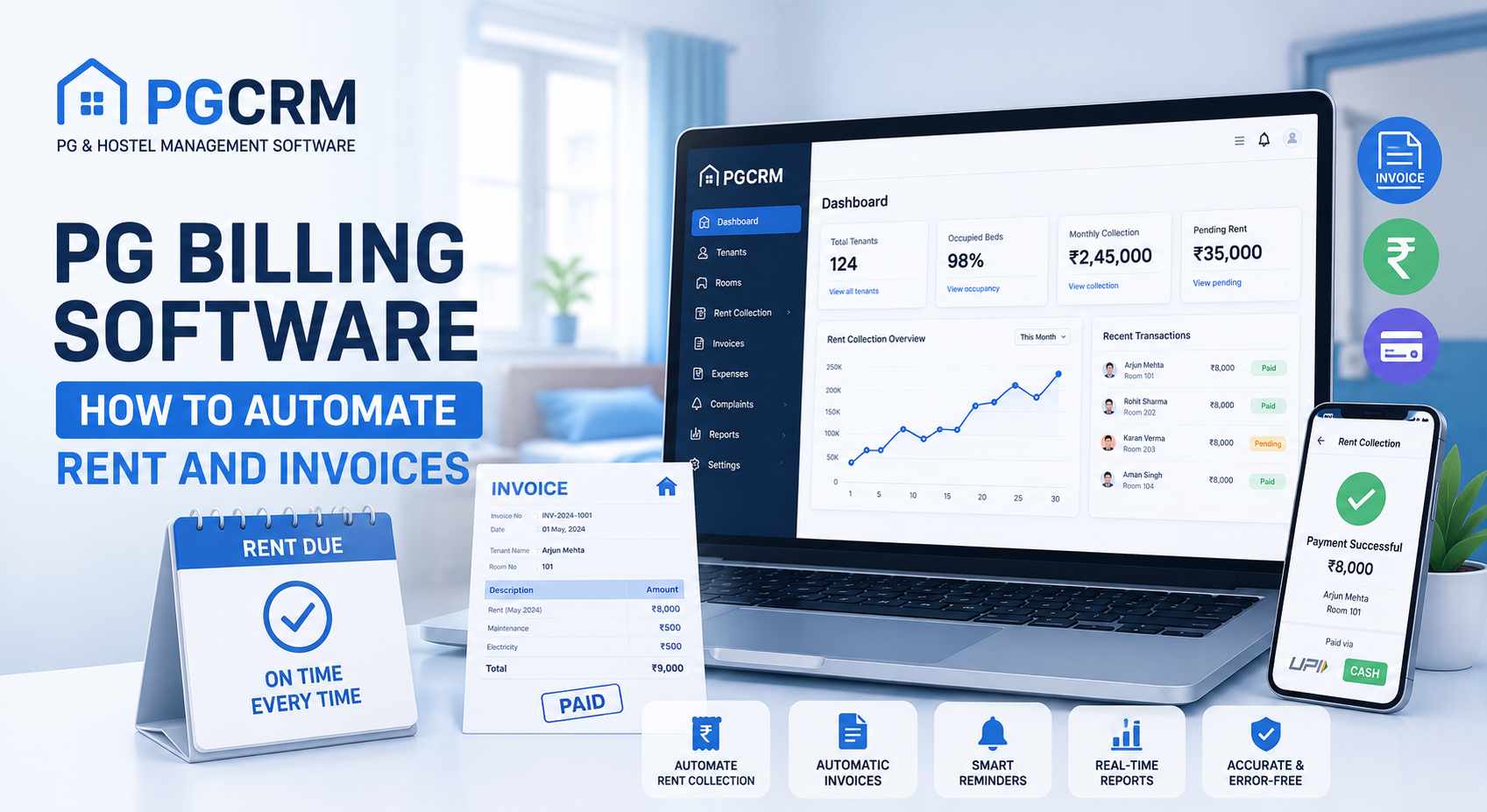
PGCRM saves each payment against a tenant, records cash and UPI, shows a live list of who has paid and who is pending, and supports monthly or join-date billing with automatic invoices. That means the billed, collected and pending numbers are largely ready by month-end, and your job is to verify them. For routines that keep the pending list short, see our guide on how to collect PG rent on time.
Step 4: Keep Deposits and Advance Rent Out of Income
This is one of the most common month-end errors. Money you hold isn’t money you’ve earned.
| Type | Treat it as | Common mistake |
|---|---|---|
| Security deposit received | A liability: money you owe back | Counting it as this month’s income |
| Deposit refunded | Reduces what you hold, not an expense | Entering it as an expense and distorting your profit |
| Advance rent | Unearned until the month it covers | Spending it or counting all of it now |
| Fines | Income when charged and collected, per your agreement | Forgetting to record them |
At month-end, write down your deposit balance (what you currently hold for tenants) and your advance rent balance. If your cash and bank balance is lower than those two combined, you have a risk to fix.
PGCRM handles deposits, fines and refunds separately from rent, so you can see them as their own entries. Keep your advance rent balance in a ledger of your own, since PGCRM doesn’t list a dedicated advance rent balance. How advance rent and deposits are treated for tax and accounting depends on your situation, so ask an accountant.
Step 5: Record Every Expense and Match It to a Bill
Missing expenses make your profit look bigger than it is. Chase them down.
A quick expense sweep
- Collect bills for the month and sort them by category: electricity, water, internet, groceries, staff, repairs, cleaning, supplies and marketing.
- Check recurring costs. Did every regular bill arrive? A missing electricity bill often means it’s still due.
- Check staff pay, including advances and leave adjustments.
- Go through cash notes. Every cash withdrawal should have a purpose recorded.
- Check large or unusual items. Repairs, appliance purchases and one-offs may belong in a different category.
- Note unpaid bills. If something belongs to this month but isn’t paid yet, record it as pending, so it doesn’t vanish.
PGCRM lets you note every expense by category and building and shows income and expense reports, so you can compare categories month to month and see which building costs the most. Keep photos or copies of bills, since PGCRM doesn’t list bill storage.
Step 6: Count the Cash and Compare It With Your Records
Cash is where small differences appear. Check it every month, not only when something feels off.
Expected cash in hand = opening cash + cash received − cash spent
Using the same assumed example:
| Item | Amount |
|---|---|
| Opening cash | ₹8,000 |
| Cash rent received | ₹52,000 |
| Cash expenses paid | ₹21,000 |
| Expected cash in hand | ₹39,000 |
| Actual cash counted | ₹38,200 |
| Difference | ₹800 short |
Then:
- Count the cash with a second person present if you can.
- Compare it with the expected figure.
- Check recent entries for the days around any gap: unrecorded expenses, change given, a tenant who paid and wasn’t noted.
- Write down any unexplained difference and what you did about it. Don’t force the numbers to match.
- Record cash handovers between staff, with a note of who gave what to whom.
Small differences happen. A growing or repeated gap means a process problem to fix.
Step 7: Match UPI and Bank Statements
For digital payments, your statements are the proof.
- Download or view the month’s UPI and bank transactions.
- Tick off each one against your rent and expense records.
- Look for payments with no matching tenant, such as a transfer from a parent’s phone or a different name.
- Look for entries in your records with no matching credit, which may mean a payment is missing, or recorded under the wrong date.
- Check refunds and reversals, since failed or reversed payments sometimes appear as paid.
If a payment doesn’t match any tenant, ask. Don’t guess. Write down the answer, and update the record.
If you use more than one account or phone for collection, list them all. Money that lands somewhere you forgot to check is the classic missing transaction.
Step 8: Investigate Differences and Fix Them Properly
Sooner or later, the numbers won’t match. Handle it calmly and in order.
- Find the size of the gap. Is it ₹50 or ₹5,000?
- Check the obvious causes first: a missed entry, a duplicate, a wrong date, a wrong tenant, an unrecorded expense.
- Compare against bills, statements and cash notes.
- Ask the people involved politely and without accusation.
- Record a correction, with a note explaining what happened, instead of overwriting the original entry.
- If you can’t find it, write down the unexplained difference and move on. Don’t hide it.
- Look for the cause so it doesn’t repeat: a missing receipt rule, a shared phone or an unclear handover.
If money is missing in a way that suggests something more than a mistake, take it seriously and get appropriate advice. Handle it carefully and fairly.
Step 9: Produce a Simple One-Page Summary
Once everything is matched, summarise the month on a single page. It’s your snapshot, and it makes next month’s comparison easy.
What to include
| Item | Example (assumed) |
|---|---|
| Occupied beds at month-end | 27 |
| Rent billed | ₹1,62,000 |
| Rent collected | ₹1,50,000 |
| Rent pending | ₹12,000 |
| Other income (fines, extras) | Per your records |
| Total expenses | Per your records |
| Surplus or shortfall | Collected income − expenses |
| Deposits held | Balance |
| Advance rent held | Balance |
| Cash in hand and bank balance | Counted and verified |
| Unexplained differences | Amount and note |
| Open items | Pending bills, disputes, follow-ups |
Add two short lines: what went well and what to fix next month. Over time, these notes become your best guide.
PGCRM shows income and expense reports and occupancy reports, which can feed straight into this summary. Compare them with your own cash and bank checks before you sign off.
Step 10: Lock the Month and File the Records
A month isn’t closed until you stop changing it.
- Mark the month closed in your register or sheet, with the date.
- Don’t edit old entries. Add corrections to the current month with a clear note.
- File the bills, statements and summary together, labelled by month.
- Back up your digital records.
- Share the summary with any partner or manager who needs it.
- Carry forward balances: cash, deposits, advance rent and pending dues.
Speak to an accountant about how long to keep records and how to handle tax and compliance, since these depend on your situation and location.
A Month-End Checklist You Can Reuse
- Cut-off date confirmed, and staff notified
- All bills, receipts and cash notes collected
- Rent billed, collected and pending matched for every tenant
- Part-month joiners and leavers checked
- Deposits and advance rent separated from income
- All expenses recorded by category, with bills attached
- Unpaid bills for the month noted
- Cash counted and compared with the expected figure
- UPI and bank statements matched with records
- Differences investigated and explained
- One-page summary prepared
- Month locked, records filed and balances carried forward
Common Mistakes in PG Month-End Accounting
- No cut-off date. The month never really ends.
- Counting deposits as income. It overstates your profit.
- Skipping small cash expenses. They add up.
- Not counting cash. Differences hide until they’re big.
- Ignoring part-month tenants. Joiners and leavers cause errors.
- Forgetting unpaid bills. Your profit looks better than it is.
- Overwriting old entries. Corrections should leave a trail.
- Using several phones or accounts without a list. Money goes missing in plain sight.
- Doing it once a quarter. Small gaps become big mysteries.
- Skipping the summary. You lose the chance to spot trends.
FAQ
What is month-end accounting for a PG?
It’s a routine at the end of each month to make sure every payment in and out is recorded and matched. You reconcile rent billed against collected, record all expenses, count the cash, check bank and UPI statements, investigate differences and summarise the month.
How do I reconcile rent at the end of the month?
List every tenant with the amount due, amount paid, date and mode. Total what you billed and what you collected, then name each pending tenant. Match the collected total against your cash records and your UPI and bank statements, and check part-month joiners and leavers carefully.
Is a security deposit income for a PG?
No. A deposit is money you hold for the tenant and usually have to return, less any agreed deductions. Keep it separate from rent in your records. How deposits are treated for tax and accounting depends on your situation, so ask an accountant.
How do I find a missing transaction in my PG accounts?
Compare your records against bills, cash notes, UPI and bank statements for the dates around the gap. Check for duplicates, wrong dates, wrong tenants and unrecorded expenses. Ask the people involved politely, and record a correction instead of overwriting the original entry.
How often should a PG close its accounts?
Every month, within the first few days of the next one. A short, regular routine catches small errors before they grow. If you handle a lot of cash or have many tenants, a quick weekly check of cash and pending rent helps too.
Can software help with PG month-end accounting?
It helps with the records. PGCRM saves payments against each tenant by cash or UPI, shows paid and pending rent, records deposits, fines and refunds, tracks expenses by category and building and shows income, expense and occupancy reports. It doesn’t list bank reconciliation or tax features, so match statements yourself.
Conclusion
Good PG month-end accounting is a calm, repeatable routine: set a cut-off, gather every record, match rent three ways, keep deposits and advance rent separate, record every expense, count the cash, match statements, investigate differences, summarise the month and lock it. Do it every month, and you’ll always know where you stand.
Clear, connected records make the routine much faster. If you want rent, payments, deposits, expenses, and reports in one place, explore PGCRM to simplify PG and hostel management.